As an optometrist who has dedicated my career to specialty contact lenses, particularly ortho-k, I’ve seen firsthand how technology has transformed our ability to help patients see clearly without daytime glasses or contacts. Here in Fayetteville, I work with families from all over Cumberland County and the Fort Liberty area, and one of the most common questions I get is about the fitting process for our sleepSEE® lenses. It’s not as simple as a standard soft lens fitting, and for a very good reason. The key to success lies in a remarkable piece of technology called a corneal topographer.
I often think of myself as a mapmaker of the eye. Before we can design a custom ortho-k lens, I need a detailed, precise map of the front surface of your eye, the cornea. That’s exactly what corneal topography gives us. It’s a digital blueprint that guides every decision we make. Without it, fitting an ortho-k lens would be like trying to navigate a complex trail system without a map—you might get close, but you’ll likely get lost. I remember a young patient from right here in Fayetteville whose previous ortho-k lenses from another practice were constantly decentering, causing blurry vision. A quick topography map revealed a slightly irregular corneal shape that had been missed. With that new, detailed information, we were able to design a new lens that fit perfectly, and he’s been seeing 20/20 ever since. It’s stories like that that remind me why this technology is so invaluable.
So, what exactly is this technology? Imagine a satellite creating a detailed 3D map of a mountain range, showing every peak, valley, and slope. Corneal topography does something very similar for your eye. It’s a non-invasive imaging technique that creates a three-dimensional map of the surface curvature of your cornea. It’s a far cry from the early days of optometry, where we could only get a few measurement points of the cornea. Today, we can get thousands of data points in a matter of seconds!
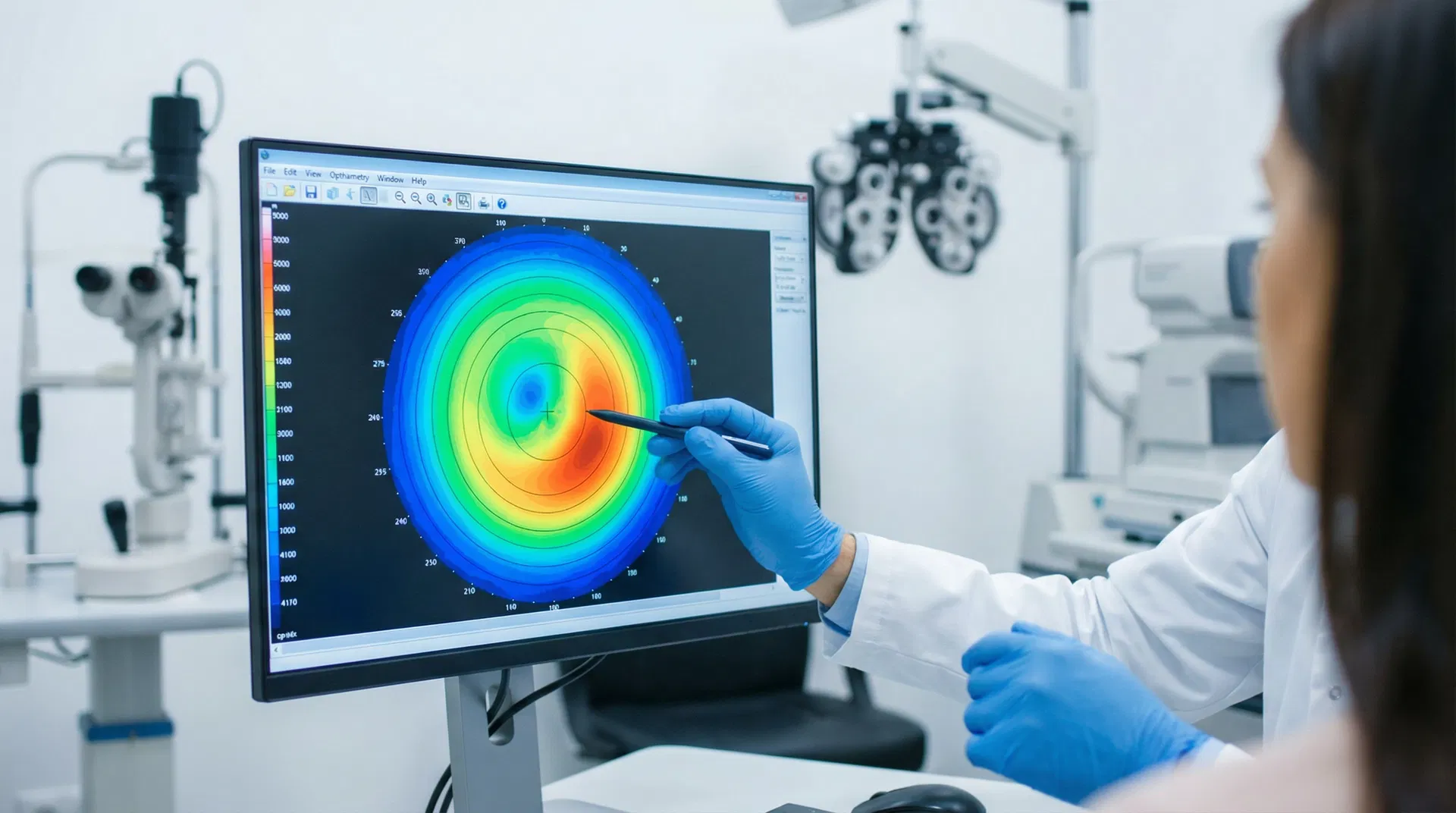
The result is a colorful map, which can look a bit like a weather radar image. But what do all those colors mean? It’s actually quite simple:
- Cool Colors (Blues and Greens): These represent the flatter areas of your cornea.
- Warm Colors (Reds and Oranges): These indicate the steeper parts of your cornea.
This map is incredibly detailed, providing a wealth of information that allows us to understand the unique geography of your eye. It’s this level of detail that is so crucial for designing a sleepSEE® lens that will gently and precisely reshape your cornea overnight. We can see not just the overall shape, but also subtle variations in curvature that would be impossible to detect otherwise.
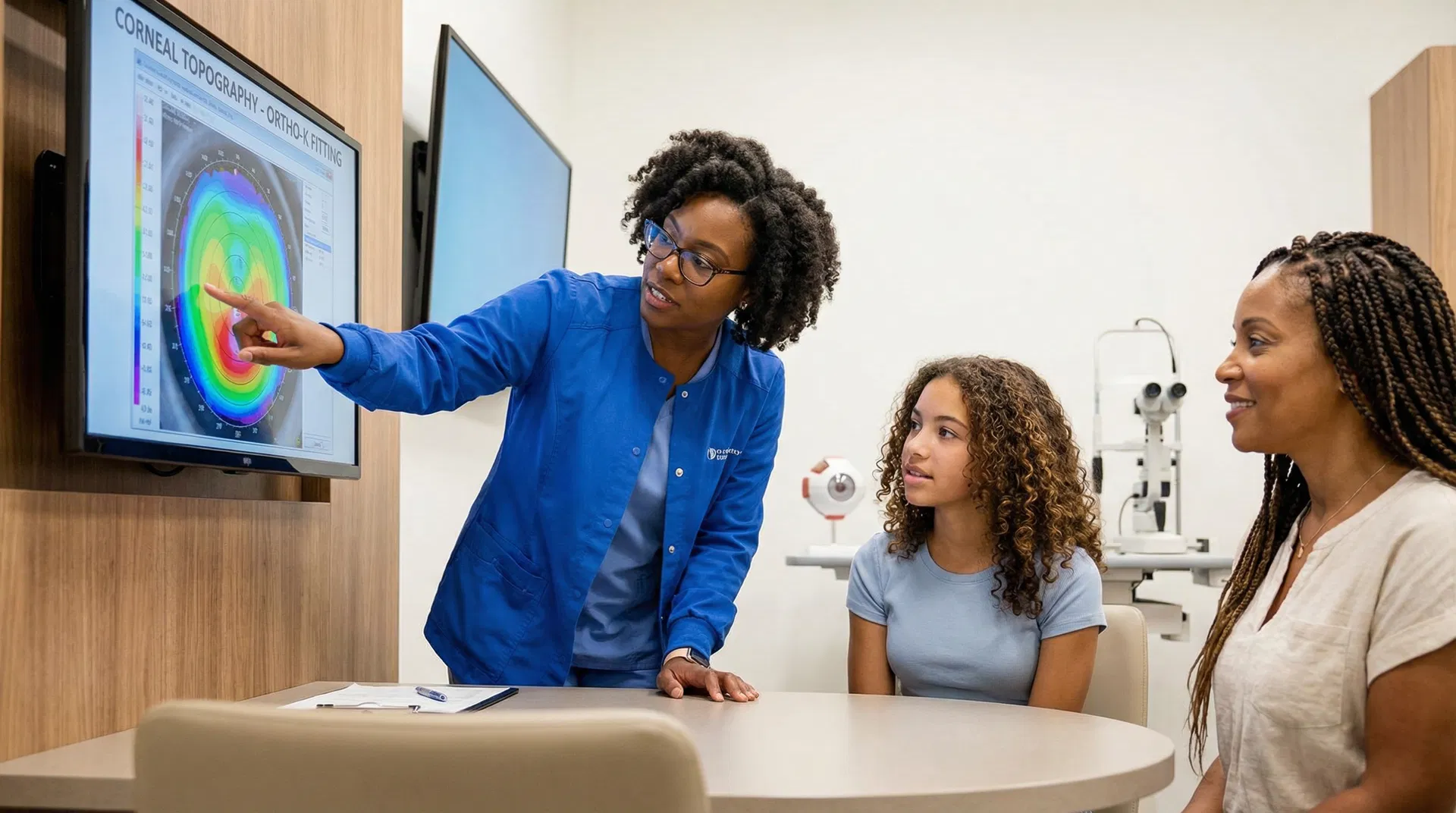
Here I am with a patient, explaining how the detailed map from our corneal topographer allows us to design a lens that is a perfect, custom fit for their unique eye shape.
Your Corneal Topography Appointment: What to Expect
Many of my patients, especially the younger ones, get a little nervous when they hear about a "test." Let me put your mind at ease. A corneal topography scan is one of the easiest and quickest things we do in our office. It’s completely painless, nothing touches your eye, and it only takes a few minutes.
You’ll sit in front of the machine and rest your chin and forehead on a comfortable support. Inside a large bowl, you’ll see a pattern of lighted rings. All you have to do is look at a central light. The machine’s camera captures the reflection of these rings off your cornea, and the computer software analyzes the pattern to create your personalized map. It’s as simple as that! We make it a fun experience for our younger patients, sometimes calling it the “eyeball picture” or the “donut game.”
Key Measurements That Guide Your Custom Lens Design
The topography map gives us a wealth of information, but there are a few key measurements that are especially important for designing ortho-k lenses. Think of these as the critical coordinates on our map.
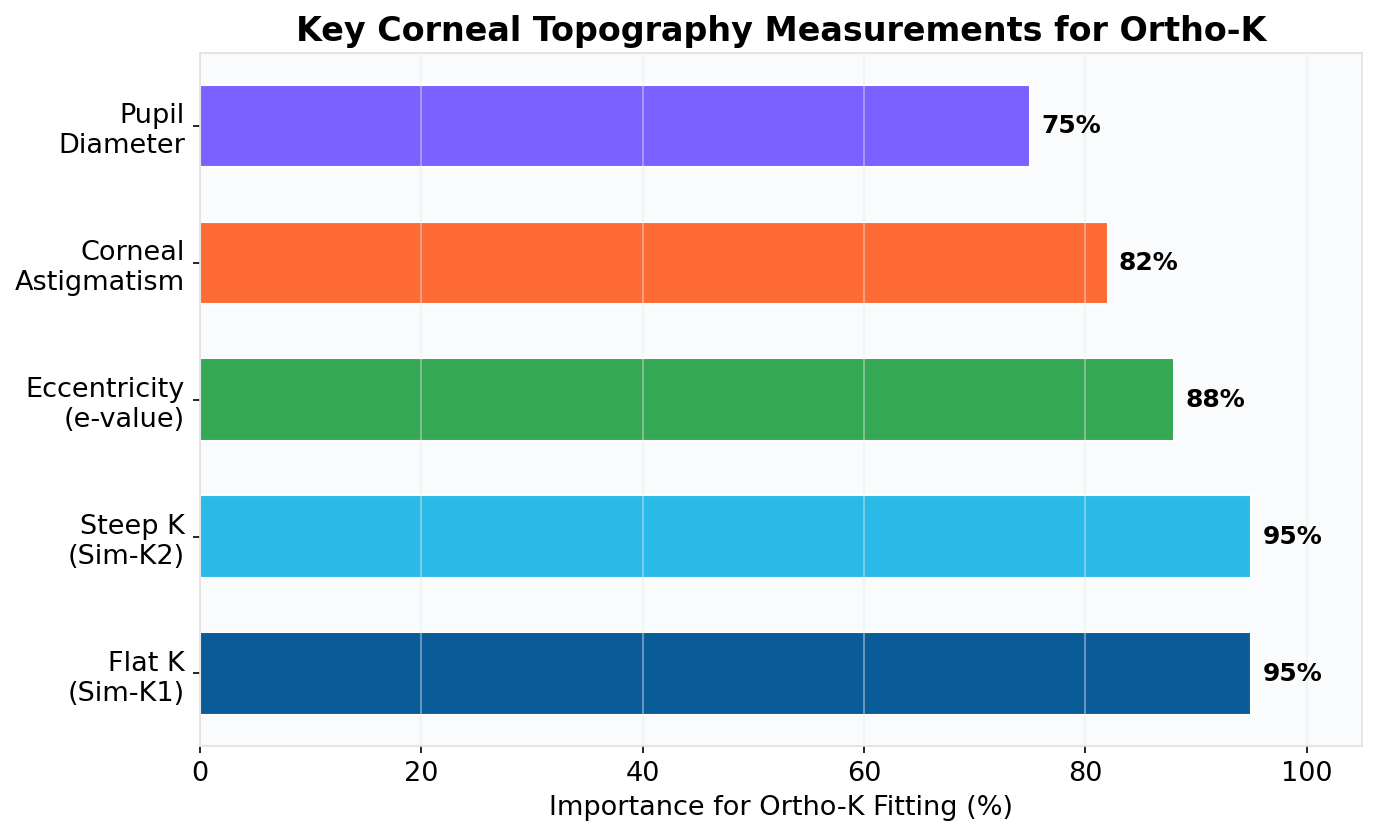
This chart shows the key measurements we analyze from your corneal topography map to design a successful sleepSEE® lens.
Here’s a simple breakdown of what these measurements mean and why they are so important:
- Simulated Keratometry (Sim-K): This measures the curvature of the central part of your cornea. It gives us a starting point for determining the power of the ortho-k lens. But it's more than just a starting point; it helps us predict how much your vision can be corrected.
- Eccentricity (e-value): This tells us how quickly the cornea flattens from the center to the periphery. A ‘normal’ cornea has a specific rate of flattening, and this measurement is crucial for ensuring the lens stays centered on your eye overnight. If the eccentricity is too high or too low, we need to adjust the lens design to prevent it from sliding out of place while you sleep. A well-centered lens is key to achieving clear and stable vision throughout the day.
- Astigmatism: This is a common condition where the cornea is shaped more like a football than a basketball. The topography map shows us the amount and orientation of the astigmatism with incredible precision. This information is vital because significant astigmatism often requires a special toric ortho-k lens design with different curves to match the irregular shape of the cornea. Without topography, we would be guessing at the best way to correct for astigmatism.
How Corneal Shape Affects Ortho-K Success
Not all corneas are created equal, and this is where corneal topography truly shines. The shape of your cornea is the single most important factor in determining if you are a good candidate for ortho-k and what your chances of success are. Here’s a table that breaks down the different corneal shapes and how they relate to ortho-k fitting.
| Corneal Shape | Description | Ortho-K Suitability | Success Rate |
|---|---|---|---|
| Prolate | Steeper in the center, flattening towards the periphery. The most common corneal shape. | Excellent | Very High |
| Oblate | Flatter in the center, steepening towards the periphery. Often the result of previous refractive surgery. | Challenging | Lower |
| Keratoconic | A cone-shaped bulge in the cornea. A medical condition that requires specialty lenses. | Not suitable for standard ortho-k | N/A |
| With-the-Rule Astigmatism | Cornea is shaped like a football lying on its side. | Good | High (often with toric lenses) |
| Against-the-Rule Astigmatism | Cornea is shaped like a football standing on its end. | Good | High (often with toric lenses) |
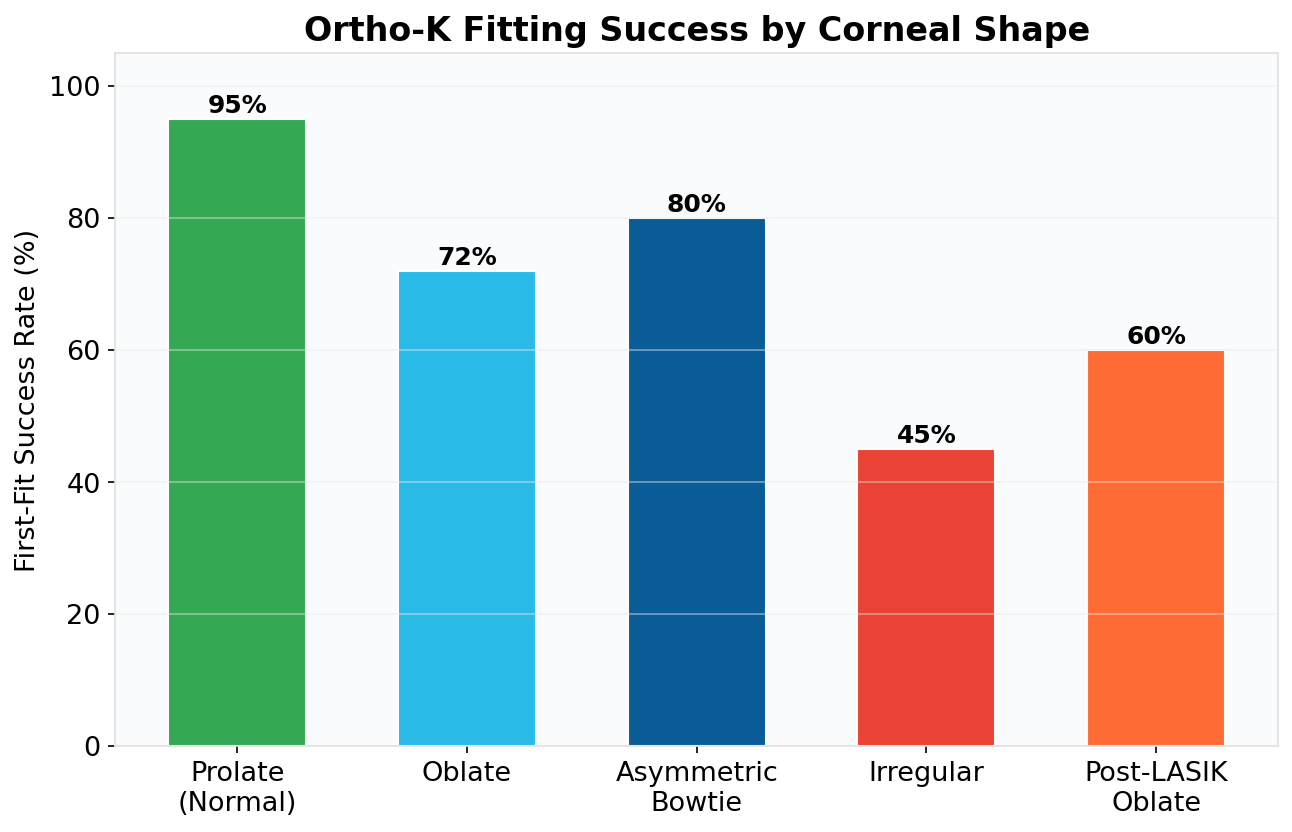
As you can see, the vast majority of patients have a corneal shape that is highly suitable for ortho-k, leading to excellent outcomes.
By understanding your unique corneal shape, I can design a sleepSEE® lens with the right curves in the right places to achieve the desired vision correction. It’s this customization that makes ortho-k so effective for myopia control. It’s a proactive approach to vision care, and it’s particularly rewarding to see the positive impact it has on the lives of my young patients from our local communities like Hope Mills and Spring Lake.
Frequently Asked Questions (FAQs)
Is corneal topography safe?
Absolutely. It is a completely non-invasive and painless procedure. Nothing touches your eye, and there are no side effects. It’s one of the safest and most common diagnostic tools we use in our practice.
How long does the appointment take?
The scan itself takes only a few minutes. I will then spend time analyzing the maps and explaining the results to you, but the entire process is very efficient. We value your time and strive to make every appointment as smooth and informative as possible.
Does insurance cover corneal topography?
In many cases, corneal topography is considered a medical necessity for fitting specialty lenses like ortho-k, but coverage can vary. Our office will help you understand your benefits. It’s important to note that sleepSEE® myopia control is a specialty service not covered by insurance. Flexible payment options and HSA/FSA funds are accepted. We believe that financial considerations should not be a barrier to quality eye care, and we will work with you to find a payment solution that fits your budget.
Why can’t I just get regular contacts?
Regular soft contact lenses simply sit on the cornea and correct vision while you are wearing them. Ortho-k lenses are different. They are designed to gently reshape the cornea overnight, providing clear vision during the day without the need for glasses or contacts. This requires a much more precise and customized fit, which is only possible with corneal topography. Think of it as the difference between buying a suit off the rack and having one custom-tailored to your exact measurements. The difference in fit and performance is remarkable.
What if I'm not a good candidate for ortho-k?
While most people are good candidates, some prescriptions or corneal shapes are not suitable for ortho-k. The good news is that the detailed information we get from the corneal topography map allows us to make that determination with a high degree of accuracy. If ortho-k is not the right option for you, we will explore other myopia control strategies or vision correction options that are a better fit for your unique needs.
The Clear Choice for Myopia Control
As you can see, corneal topography is not just another test; it is the foundation of a successful ortho-k treatment. It allows us to move beyond a one-size-fits-all approach and into the realm of truly personalized medicine. For my patients here in the Fayetteville area, from young children just starting their myopia control journey to adults who want freedom from daytime eyewear, this technology is a game-changer. It’s about more than just clear vision; it’s about providing a better quality of life.
If you’re interested in learning more about how sleepSEE® can help you or your child, I encourage you to read more on our blog, see how it works, or even take our candidacy quiz. When you’re ready, you can find a provider and schedule a consultation. We are committed to providing the highest level of care, and that starts with a perfect map of your eyes.
For further reading, I recommend these resources from the American Academy of Ophthalmology [1] and the National Eye Institute [2].
References
[1] American Academy of Ophthalmology. Corneal Topography. https://www.aao.org/eye-health/treatments/corneal-topography-4
[2] National Eye Institute. Myopia. https://www.nei.nih.gov/learn-about-eye-health/eye-conditions-and-diseases/myopia-nearsightedness
Last reviewed: February 2026
Free Download: The Science Behind Ortho-K
A plain-language summary of 12 key clinical studies on orthokeratology efficacy.
- Summary of 12 peer-reviewed clinical studies
- Myopia progression rates with/without treatment
- Ortho-K vs. atropine vs. multifocal lenses
- FDA approval history and safety data
Ortho-K Research Summary
Science & Evidence — Free PDF
Dr. James Singletary, OD, FIAOMC
Dr. James Singletary, OD, FIAOMC is a contributor to the sleepSEE Insights blog, sharing expert knowledge on myopia progression, orthokeratology (Ortho-K) and myopia control.