As an optometrist who has dedicated my career to the field of myopia control, I’ve had the privilege of witnessing the evolution of orthokeratology firsthand. I remember when we first started offering ortho-k in our Fayetteville practice. The idea of correcting vision overnight seemed almost like science fiction to many of my patients. But as the years rolled on, I saw more than just clear daytime vision. I saw a powerful tool that was genuinely changing the trajectory of our young patients' eyesight for the better. Now, with decades of data to draw upon, the question I often get is, "That sounds great, Dr. Singletary, but what happens in the long run? Is it safe? Does it keep working?"
These are the right questions to ask. As a practitioner and a parent, I understand that long-term health is the ultimate priority. Today, I want to pull back the curtain and share what over 20 years of clinical data and real-world experience tell us about the long-term outcomes of orthokeratology. It’s a story of sustained success, remarkable safety, and lasting benefits that extend far beyond simply not wearing glasses during the day.
Table of Contents
- Sustained Myopia Control: Does the Effect Last?
- The Long-Term Safety Profile of Ortho-K
- Short-Term Adaptation vs. Long-Term Stability
- What Happens When Ortho-K is Discontinued?
- A View from Our Clinic: 20 Years of Success Stories
- Frequently Asked Questions
Sustained Myopia Control: Does the Effect Last?
One of the most significant concerns for parents and patients is whether the myopia control effect of ortho-k diminishes over time. Will my child’s eyes just start growing faster after a few years? The evidence overwhelmingly says no. Multiple long-term studies, some following patients for up to 10 and even 18 years, have demonstrated that the treatment effect is not a short-term fluke. It is a sustained, long-lasting benefit. [1] [2]
These studies measure the axial length of the eye—the most accurate way to track the physical progression of myopia. What they consistently find is that children undergoing ortho-k treatment show a significantly slower rate of axial elongation compared to their peers in glasses or standard contact lenses. This isn't just for a year or two. The data shows this slowing effect is maintained year after year, providing a cumulative benefit that can dramatically reduce the final level of myopia a child reaches in adulthood.
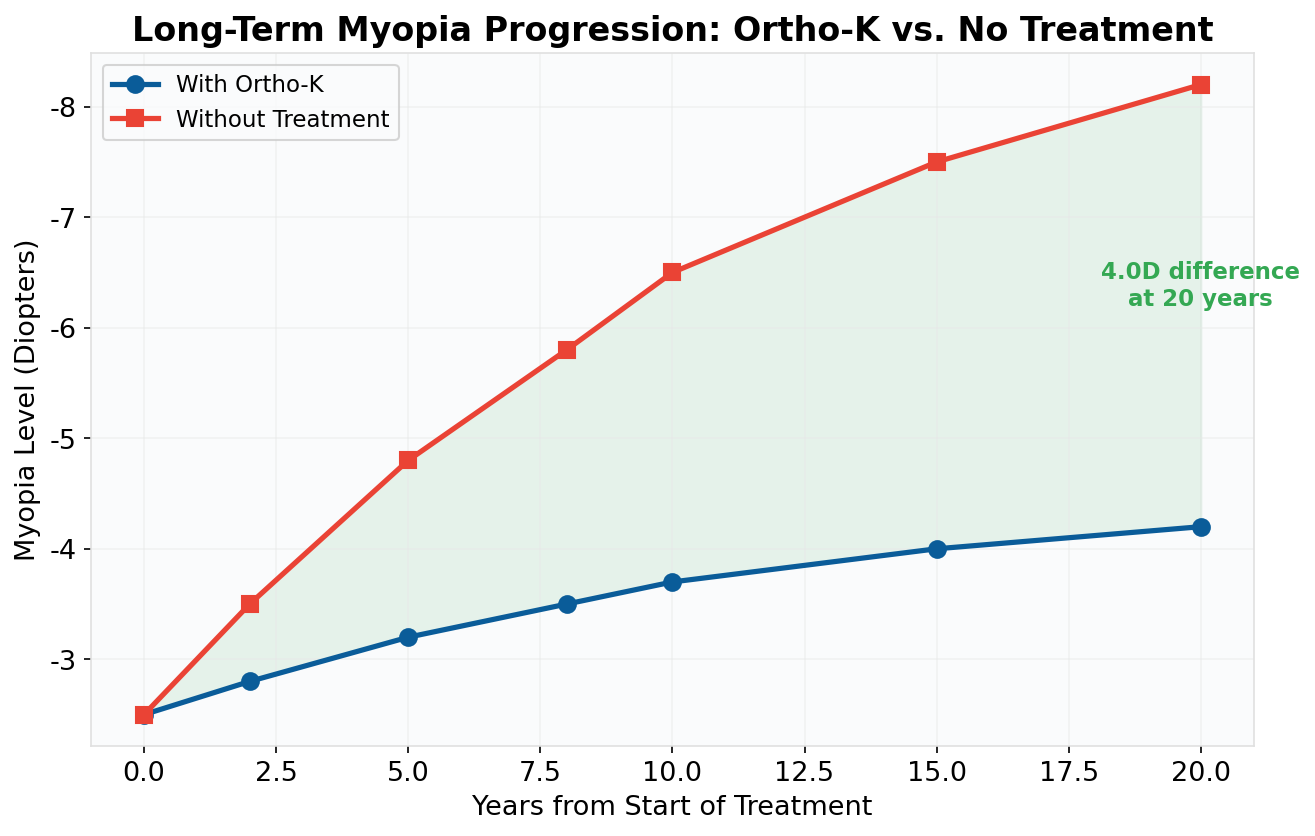
This chart illustrates the powerful, cumulative effect of long-term ortho-k treatment. While some progression is normal as a child grows, the rate is significantly flattened, leading to a much lower final prescription and a healthier eye.
This long-term efficacy is the cornerstone of why we recommend ortho-k so confidently. We aren't just providing a temporary fix; we are actively managing a progressive condition to secure a healthier visual future for our patients.
The Long-Term Safety Profile of Ortho-K
Effectiveness is only half the story. As a medical treatment, safety is paramount. So, what does the data say about wearing these lenses night after night for a decade or more? The safety record of modern orthokeratology is excellent, especially when managed by a qualified and experienced practitioner. The risk of serious complications, like microbial keratitis, is very low and comparable to other overnight contact lens modalities. [3]
Long-term studies confirm that the most common issues are minor and reversible, such as corneal staining or dryness. These are typically managed with adjustments to the lens fit, materials, or care routine. One 10-year study found that while about 10% of wearers experienced some kind of adverse event over the decade, these were primarily minor issues like conjunctivitis that resolved without any long-term impact on vision or eye health. [4]
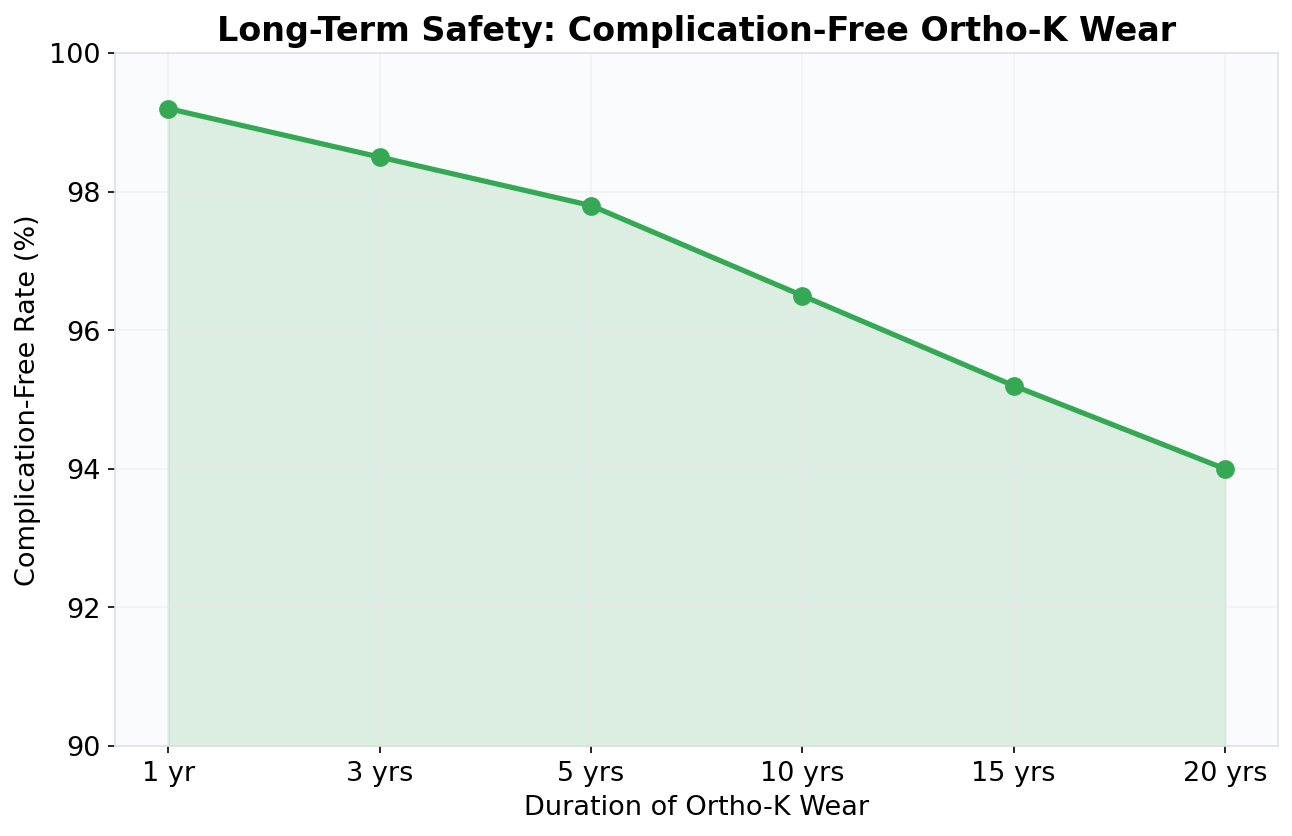
When we look at the data in terms of "patient-years," the safety profile is incredibly strong. The vast majority of wearers experience no issues year after year, highlighting the safety of this technology when properly managed.
Recent research has also looked at the very long-term health of the cornea and surrounding structures, like the meibomian glands. While some studies note subtle changes in the tear film or gland structure after many years of wear, these have not been linked to significant clinical problems or a need to cease treatment. [5] It simply underscores the importance of regular, comprehensive eye health examinations, which are a standard part of our sleepSEE® program here in Cumberland County.
Short-Term Adaptation vs. Long-Term Stability
It’s helpful to think about ortho-k in two distinct phases: the initial adaptation and the long-term maintenance. The first few weeks are about your cornea adapting to the lens and achieving clear, stable vision. The long-term phase is about maintaining that result and, crucially, controlling myopia progression. Here’s how they compare:
| Feature | Short-Term (First 1-3 Months) | Long-Term (1-20+ Years) |
|---|---|---|
| Primary Goal | Achieve clear, stable daytime vision | Maintain clear vision & control axial elongation |
| Vision Quality | May fluctuate slightly day-to-day | Consistently clear and stable |
| Follow-Up Care | More frequent visits for fit assessment | Routine annual or semi-annual health checks |
| Lens Sensation | Mild initial awareness of the lens is common | Lenses are generally not felt during sleep |
| Key Outcome | Freedom from glasses/daytime contacts | Significantly reduced lifetime myopia, lower risk of eye disease |
Understanding this distinction is key. The initial "wow" of clear vision is just the beginning. The real, life-changing benefit is the quiet, steady work the lenses are doing year after year to protect your child’s long-term eye health.
What Happens When Ortho-K is Discontinued?
This is a common and important question. What if my child decides to stop wearing the lenses as a teenager or young adult? First, the refractive effect—the part that corrects vision—is completely reversible. Over a period of a few days to weeks, the cornea will gradually return to its original shape, and the myopia will return to its pre-treatment level. The patient would simply need to resume wearing glasses or daytime contacts.
But here’s the critical part: the myopia control benefit is not lost. If a child wore ortho-k from age 10 to 18 and their prescription was held stable, stopping treatment at 18 doesn’t cause their eyes to suddenly "catch up" on all the growth that was prevented. The structural benefit of a shorter, healthier eye is permanent. They will still have a lower prescription and a lower risk of myopia-related diseases for the rest of their lives compared to if they had never undergone treatment at all. [6]
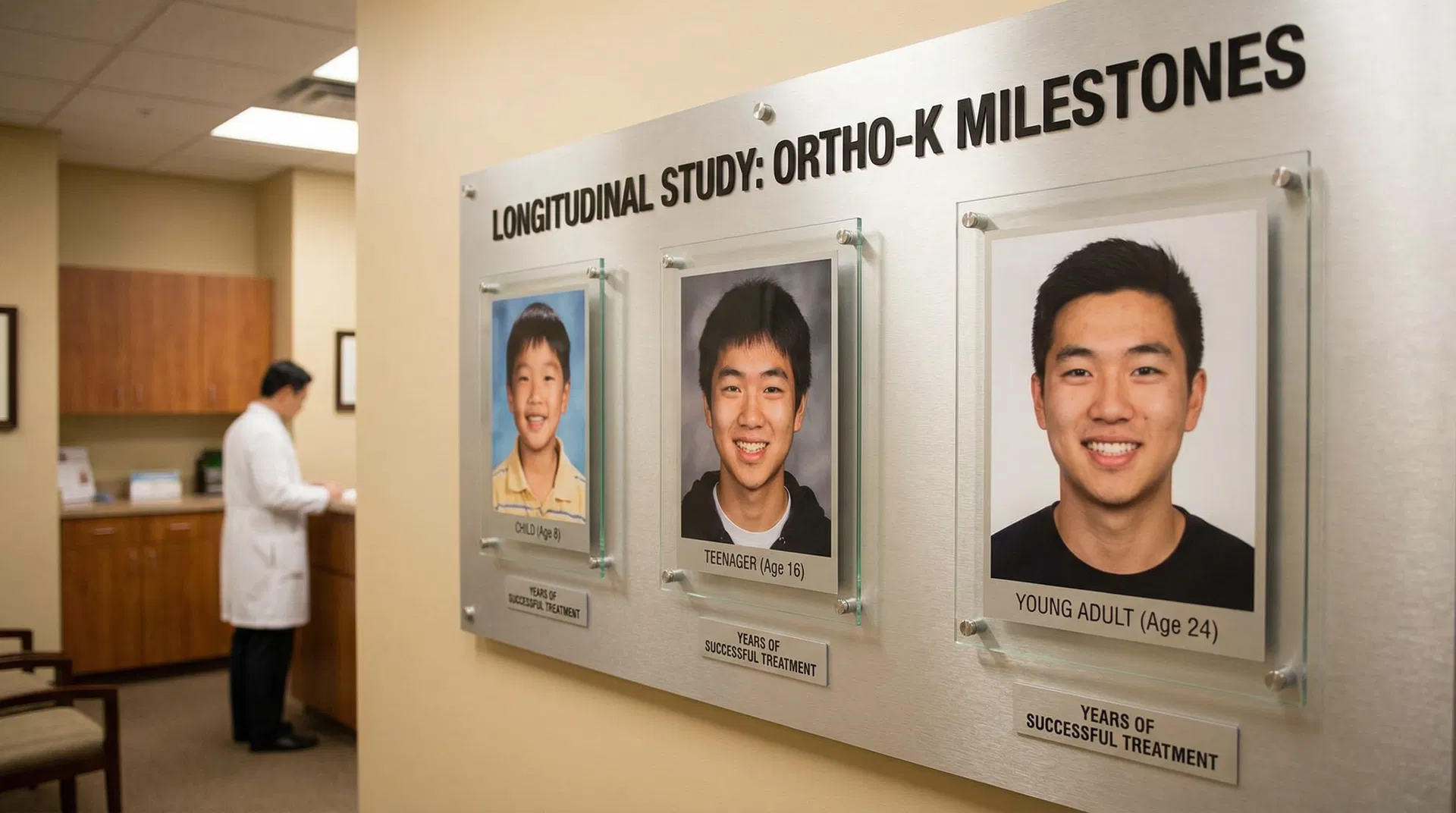
Think of it like this: Ortho-K changes the final destination. Even if you stop the treatment, you are still at a much better, healthier endpoint than if you had never started the journey.
A View from Our Clinic: 20 Years of Success Stories
Data and studies are essential, but the real proof is in the people we serve. I think of a patient, let’s call him Michael, whose parents brought him to our Fayetteville office years ago. They were a military family stationed at Fort Liberty, and they were worried. Michael’s prescription was jumping every six months. We started him on sleepSEE® ortho-k when he was 11. Today, he’s a college student. He stopped wearing his lenses a year ago because he wanted the option to wear cosmetic contacts occasionally. His prescription is a fraction of what we projected it would be, and his eyes are healthy. His parents recently told me that putting him in ortho-k was one of the best decisions they ever made for him.
These are the stories that the long-term data represents. It’s about giving kids from Fayetteville, Fort Liberty, and all over Cumberland County the chance to not just see clearly today, but to have healthier eyes for a lifetime. It’s a commitment I’ve been proud to make for over two decades.
Making this advanced care accessible is a priority for us. While sleepSEE® myopia control is a specialty service not covered by insurance, we believe in making it manageable for families. We offer flexible payment options, and you can use your Health Savings Account (HSA) or Flexible Spending Account (FSA) funds to cover the cost of treatment.
Ready to learn more about the science? Explore our other articles on the blog [blocked] and see exactly how it works [blocked]. You can also find a provider [blocked] near you or take our candidacy quiz [blocked] to see if it’s the right fit for you or your child.
Frequently Asked Questions
1. Is it safe to wear ortho-k lenses for 10, 15, or even 20 years?
Yes, extensive long-term data shows that when properly fitted and cared for under the supervision of an experienced optometrist, ortho-k is a very safe option for long-term vision correction and myopia control. The risk of serious complications is low, and regular check-ups ensure the continued health of the eye.
2. Will my child's vision get worse again if they stop wearing ortho-k lenses?
When treatment is stopped, the cornea returns to its original shape, and the refractive error (the need for glasses) will return. However, the primary benefit of myopia control—the slowed growth of the eye—is permanent. The eye will not "catch up" on the growth that was prevented, resulting in a permanently lower prescription than if no treatment was used.
3. Does the myopia control effect wear off after a few years?
No. Studies that have followed patients for a decade or more show that the rate of eye growth remains significantly slowed for as long as the patient continues with treatment. The effect is consistent and cumulative over the long term.
4. Are there any permanent changes to the eye after long-term ortho-k wear?
The primary goal is a permanent benefit: a less myopic eye. The refractive treatment itself is reversible. While very long-term wear may lead to subtle, clinically insignificant changes in some corneal or tear film characteristics, these have not been shown to cause harm and are monitored during routine eye health exams.
Last reviewed: February 2026
References
[1] Santodomingo-Rubido, J., Villa-Collar, C., Gil-Martin, B., & Gutiérrez-Ortega, R. (2018). Safety and efficacy following 10-years of overnight orthokeratology for myopia control. Ophthalmic and Physiological Optics, 38(3), 295-305. https://onlinelibrary.wiley.com/doi/10.1111/opo.12460
[2] Gispets, J., Yébana, P., Lupón, N., Cardona, G., & Fadur, A. (2022). Efficacy, predictability and safety of long-term orthokeratology: An 18-year follow-up study. Contact Lens and Anterior Eye, 45(3), 101501. https://www.sciencedirect.com/science/article/pii/S136704842100165X
[3] Liu, Y. M., & Xie, P. (2016). The safety of orthokeratology—a systematic review. Eye & contact lens, 42(1), 35-42. https://journals.lww.com/claojournal/fulltext/2016/01000/the_safety_of_orthokeratology_a_systematic_review.6.aspx
[4] Myopia Profile. (2022, September 6). Optimizing safety in orthokeratology. https://www.myopiaprofile.com/articles/optimizing-safety-in-orthokeratology
[5] Carracedo, G., Martin-Gil, A., & Pintor, J. (2020). Long-term effect of orthokeratology on the anterior segment length. Contact Lens and Anterior Eye, 43(5), 493-497. https://www.sciencedirect.com/science/article/pii/S1367048416300133
[6] Cho, P., & Cheung, S. W. (2012). Retardation of myopia in Orthokeratology (ROMIO) study: a 2-year randomized clinical trial. Investigative ophthalmology & visual science, 53(11), 7077-7085. https://iovs.arvojournals.org/article.aspx?articleid=2127470
Free Download: The Science Behind Ortho-K
A plain-language summary of 12 key clinical studies on orthokeratology efficacy.
- Summary of 12 peer-reviewed clinical studies
- Myopia progression rates with/without treatment
- Ortho-K vs. atropine vs. multifocal lenses
- FDA approval history and safety data
Ortho-K Research Summary
Science & Evidence — Free PDF
Dr. James Singletary, OD, FIAOMC
Dr. James Singletary, OD, FIAOMC is a contributor to the sleepSEE Insights blog, sharing expert knowledge on myopia progression, orthokeratology (Ortho-K) and myopia control.