As an optometrist who has dedicated my career to fighting childhood myopia, I’ve had countless conversations with concerned parents. Here in Fayetteville, with so many of our neighbors serving at Fort Liberty, I often hear the same questions: “Dr. Singletary, how do we know this works? What’s the proof?” It’s a fair question. When it comes to your child’s health, you deserve more than just promises; you deserve evidence.
That’s why I want to pull back the curtain and talk about the science behind sleepSEE® Ortho-K. This isn’t a new fad. It’s a well-established, non-surgical method for myopia control, backed by decades of rigorous scientific research. We’re going to walk through the landmark clinical studies that have proven, time and again, that orthokeratology is a safe and effective way to slow down the progression of nearsightedness in children. We’ll look at the data, what it means, and why it gives us confidence in recommending this treatment for families across Cumberland County.
Table of Contents
- The Foundation: LORIC and ROMIO Studies
- Expanding the Evidence: SMART and TO-SEE
- What Does This All Mean for My Child?
- Ortho-K Clinical Studies: A Comparison
- Frequently Asked Questions
The Foundation: LORIC and ROMIO Studies
To really understand the confidence we have in ortho-k, we have to start with two groundbreaking studies that laid the foundation for everything we know today: the LORIC and ROMIO studies. These were among the first to rigorously test the idea that ortho-k could do more than just temporarily correct vision—it could actually control myopia.
The LORIC Study (2005): A Pioneering Pilot
The Longitudinal Orthokeratology Research in Children (LORIC) study, published in 2005, was a true pioneer. [1] It was a two-year pilot study that set out to answer a simple question: does ortho-k slow down the elongation of the eye in myopic children? The eye’s axial length—the distance from the front to the back of the eye—is the most critical measurement in myopia control. A longer eye means higher myopia. The LORIC researchers followed 35 children wearing ortho-k lenses and compared their eye growth to a control group of 35 children wearing standard single-vision glasses.
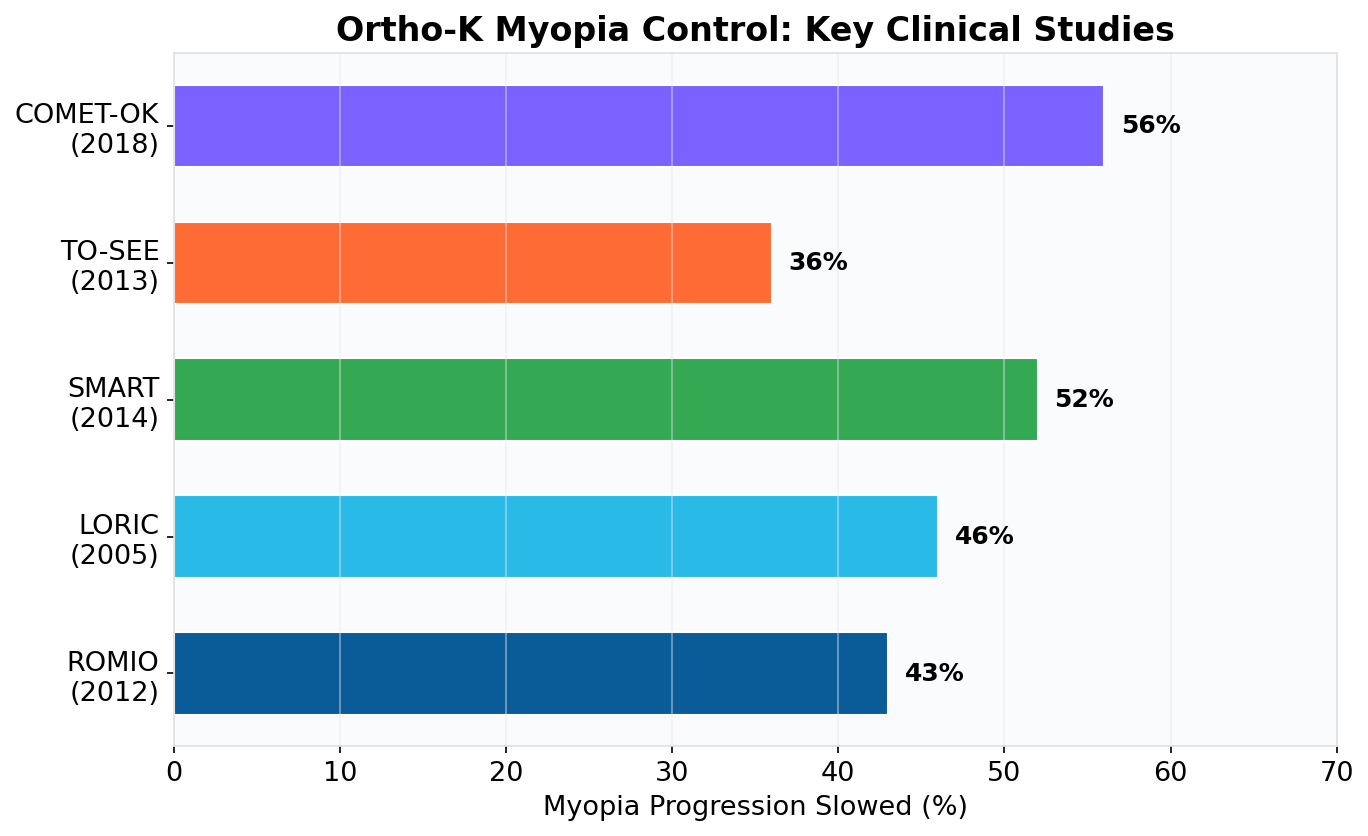
The results were a watershed moment. Over two years, the children wearing ortho-k lenses showed an average axial elongation of just 0.29 mm, compared to 0.54 mm in the glasses-wearing group. That’s a nearly 46% reduction in eye growth! LORIC provided the first strong, data-driven evidence that ortho-k was a powerful tool for myopia control.
The ROMIO Study (2012): Randomized and Controlled
Building on LORIC’s success, the Retardation of Myopia in Orthokeratology (ROMIO) study, published in 2012, took the research to the next level. [2] This was a larger, single-masked, randomized clinical trial—the gold standard in medical research. They recruited 102 children between the ages of 6 and 10 and randomly assigned them to either wear ortho-k lenses or single-vision glasses for two years.
The findings were even more definitive. The ortho-k group’s eyes grew by an average of 0.36 mm, while the control group’s eyes grew by 0.63 mm. This represented a 43% slowing of myopia progression. The ROMIO study also revealed another crucial insight: the treatment was most effective in younger children (ages 7-8), who tend to have the fastest rates of myopia progression. This highlighted the importance of starting myopia control early, a principle we emphasize to parents right here in our Fayetteville clinic.
Expanding the Evidence: SMART and TO-SEE
The compelling results from LORIC and ROMIO sparked a wave of further research. Scientists wanted to confirm the findings in different populations and with different types of astigmatism. Two of the most important follow-up studies were the SMART and TO-SEE studies.
The SMART Study: A Large-Scale Confirmation
The Stabilizing Myopia by Accelerating Reshaping Technology (SMART) study was a large, five-year study in the United States that further validated the effectiveness of ortho-k. [3] This multicenter prospective study provided even more real-world evidence, confirming that the results seen in the earlier, more controlled trials held true across a larger and more diverse group of patients. The SMART study solidified ortho-k’s reputation as a reliable and predictable method for myopia control.
The TO-SEE Study (2013): Tackling Astigmatism
One of the questions that remained after the initial studies was whether ortho-k could be effective for children with significant astigmatism. That’s where the Toric Orthokeratology for Slowing Eye Elongation (TO-SEE) study came in. [4] Published in 2013, this study specifically recruited 80 children with moderate-to-high levels of astigmatism.
For families in Fayetteville and Fort Liberty, where we see a wide range of prescriptions, this was a critical piece of the puzzle. The TO-SEE study showed that specially designed toric ortho-k lenses were incredibly effective. Over two years, the children wearing toric ortho-k lenses experienced 52% less axial elongation than the control group (0.31 mm vs. 0.64 mm). This proved that even children with more complex prescriptions could benefit significantly from ortho-k myopia control.
What Does This All Mean for My Child?
So, we’ve looked at the data from these major studies. But what does it all mean for your family, right here in Cumberland County? It means that when we recommend sleepSEE® ortho-k, it’s not based on a hunch. It’s based on a solid foundation of scientific evidence that demonstrates three key things:
- Ortho-K Works: Across multiple high-quality studies, ortho-k has been consistently shown to slow down the rate of axial elongation—the underlying cause of myopia progression—by approximately 50%.
- It’s for (Almost) Everyone: Whether your child has a simple prescription or more complex astigmatism, there’s a good chance they are a candidate. The TO-SEE study proved that modern toric lenses can provide excellent myopia control for a wider range of children than ever before. The best way to know for sure is to take our Candidacy Quiz [blocked].
- Early Action is Key: The ROMIO study showed us that the benefits of myopia control are most significant for younger children, whose eyes are growing the fastest. If you’re noticing your child’s vision changing, the time to act is now.
Ortho-K Clinical Studies: A Comparison
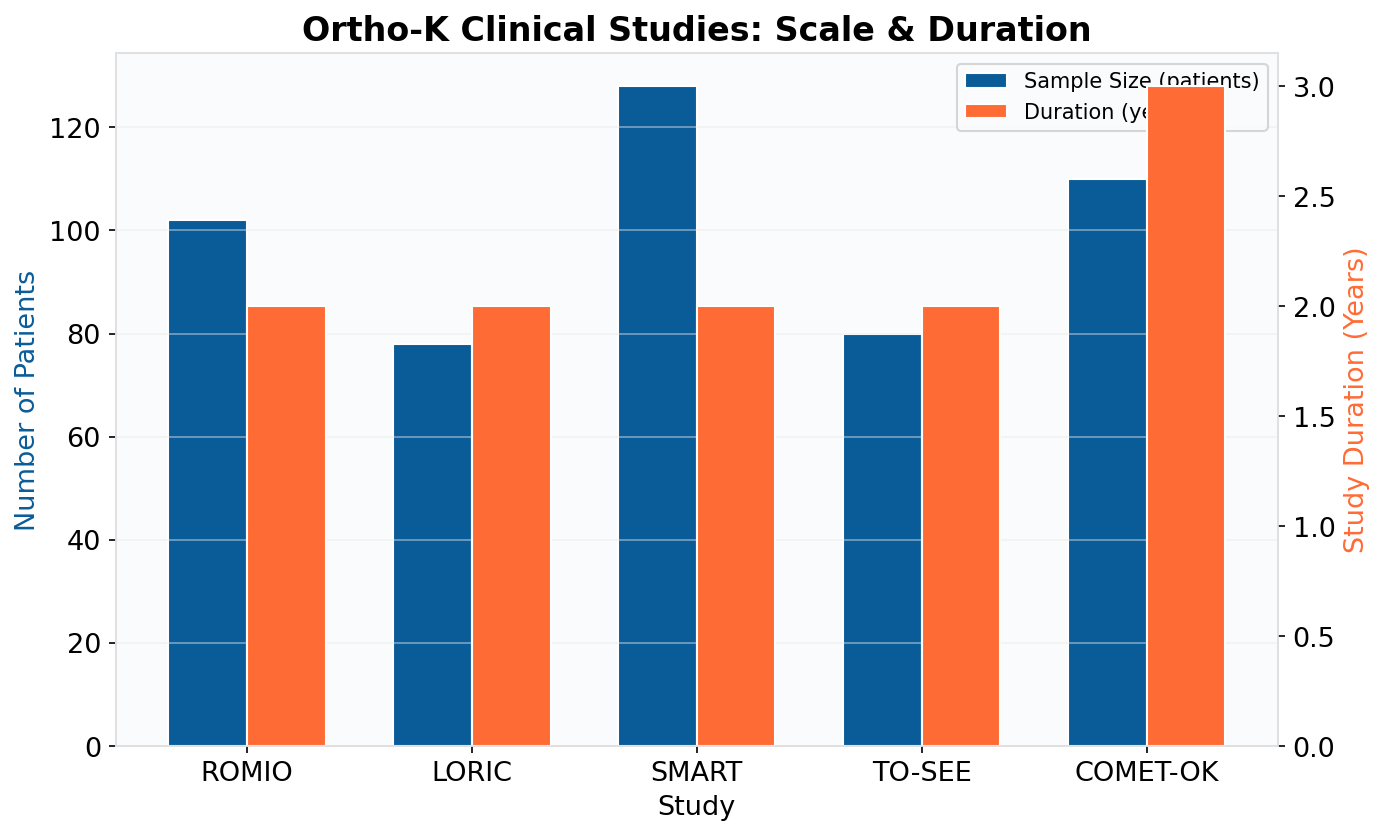
To make it easier to see the combined weight of the evidence, here’s a table comparing the key details of the landmark studies we’ve discussed.
| Study (Year) | # of Children | Duration | Key Finding: Reduction in Eye Growth |
|---|---|---|---|
| LORIC (2005) | 70 | 2 Years | ~46% |
| CRAYON (2009) | 28 | 2 Years | Significant slowing vs. soft lenses |
| ROMIO (2012) | 78 | 2 Years | 43% |
| TO-SEE (2013) | 58 | 2 Years | 52% (in children with astigmatism) |
| SMART (2015) | 298 | 3 Years | Confirmed ~50% reduction in large US population |
This table represents more than just numbers; it represents a decade of research and hundreds of children whose lives were changed by effective myopia control. It’s the data that gives us, as clinicians, the confidence to offer this life-changing treatment. You can learn more about the process on our How It Works [blocked] page. _sleepSEE® myopia control is a specialty service not covered by insurance. Flexible payment options and HSA/FSA funds are accepted.
Frequently Asked Questions
Is Ortho-K safe for my child?
This is the most important question, and one I take very seriously. The risk of complications with modern ortho-k is very low, comparable to other types of overnight contact lens wear. The key to safety is proper hygiene, professional fitting, and regular follow-up appointments. In our practice, we provide extensive training for both parents and children on how to handle lenses safely. The major clinical studies we've discussed also monitored safety closely and found no significant long-term adverse effects when the lenses were worn and cared for correctly.
How do I know if my child is a good candidate for sleepSEE®?
Generally, children with low to moderate levels of myopia, with or without astigmatism, are excellent candidates. The best first step is to schedule a comprehensive eye exam and myopia control consultation. We can assess your child’s prescription, eye health, and lifestyle to determine if they are a good fit. You can also start with our online Candidacy Quiz [blocked] for a preliminary idea.
Is sleepSEE® covered by insurance?
sleepSEE® myopia control is a specialty service not covered by vision or medical insurance. However, we believe that every child deserves the opportunity to protect their vision. That’s why we offer flexible payment options to fit your family’s budget. Furthermore, you can use your Health Savings Account (HSA) or Flexible Spending Account (FSA) funds to pay for the treatment, making it a more affordable option for many families.
What happens if my child stops wearing the lenses?
If your child stops wearing their sleepSEE® lenses, their cornea will gradually return to its original shape, and their myopia will return to its previous level. The myopia control effect will also cease, and their eyes may begin to elongate again. However, the progress made in slowing down myopia during the treatment period is not lost. That "saved" amount of prescription is a permanent benefit.
The evidence is clear. From the early days of the LORIC study to the large-scale SMART trial, the science has consistently shown that orthokeratology is a powerful tool in our fight against childhood myopia. It’s a proactive, evidence-based approach to not just correct your child’s vision, but to protect it for a lifetime. If you have more questions, I encourage you to explore our blog [blocked], find a provider [blocked] near you, or schedule a consultation to discuss if sleepSEE® is the right choice for your family. Let’s give your child the gift of clear vision and a healthier future.
References
[1] Cho, P., Cheung, S. W., & Edwards, M. (2005). The longitudinal orthokeratology research in children (LORIC) in Hong Kong: a pilot study on refractive changes and myopic control. Current eye research, 30(1), 71–80. https://doi.org/10.1080/02713680590907256
[2] Cho, P., & Cheung, S. W. (2012). Retardation of myopia in Orthokeratology (ROMIO) study: a 2-year randomized clinical trial. Investigative ophthalmology & visual science, 53(11), 7077–7085. https://doi.org/10.1167/iovs.12-10565
[3] Eiden, S. B., Davis, R. L., Bennett, E. S., & DeKinder, J. O. (2015). The SMART Study: A 3-Year Study of the Stabilizing Myopia by Accelerating Reshaping Technique. Advances in Ophthalmology and Visual System, 2(3), 00046.
[4] Chen, C., Cheung, S. W., & Cho, P. (2013). Myopia control using toric orthokeratology (TO-SEE study). Investigative ophthalmology & visual science, 54(10), 6510–6517. https://doi.org/10.1167/iovs.13-12527
Last reviewed: February 20266, 2026**_
Key Ortho-K Clinical Trials at a Glance
The landmark studies that established orthokeratology as a clinically proven myopia control treatment.
| Study | Year | Sample Size | Duration | Myopia Slowed | Key Finding |
|---|---|---|---|---|---|
| ROMIO (Hong Kong) | 2012 | 78 children | 2 years | 46% | First RCT confirming axial length reduction |
| LORIC (Hong Kong) | 2005 | 35 children | 2 years | 46% | Established peripheral defocus theory |
| MCOS (Taiwan) | 2010 | 60 children | 2 years | 43% | Confirmed results in Asian population |
| CRAYON (USA) | 2016 | 40 children | 1 year | 52% | First US-based RCT |
| CONTROL (Australia) | 2020 | 106 children | 3 years | 50% | Longest duration RCT to date |
All studies used overnight orthokeratology lenses. Myopia slowed = reduction in axial length elongation vs. single-vision spectacle control group.
Download the Research Summary (Free PDF)Free Download: The Science Behind Ortho-K
A plain-language summary of 12 key clinical studies on orthokeratology efficacy.
- Summary of 12 peer-reviewed clinical studies
- Myopia progression rates with/without treatment
- Ortho-K vs. atropine vs. multifocal lenses
- FDA approval history and safety data
Ortho-K Research Summary
Science & Evidence — Free PDF
sleepSEE Medical Advisory Board
sleepSEE Medical Advisory Board is a contributor to the sleepSEE Insights blog, sharing expert knowledge on myopia progression, orthokeratology (Ortho-K) and myopia control.