As an optometrist here in Fayetteville, I’ve dedicated my career to helping families navigate the challenges of childhood myopia. For years, I’ve seen the worry in parents’ eyes as their child’s prescription gets stronger and stronger with each visit. We’ve all been told that glasses are the solution, but what if I told you they might only be a temporary fix, and could even be contributing to the problem? It sounds counterintuitive, I know, but it all comes down to a fascinating concept called “peripheral defocus.”
I remember a young patient I had a few years ago, a bright kid from a family stationed at Fort Liberty. Let's call him Sam. Sam was a classic case. He loved to read and was a whiz on the computer, but he was spending less and less time playing outside. Every year, like clockwork, his vision would get a little worse, and his glasses a little thicker. His parents were diligent, ensuring he wore his glasses all the time, but the myopia was still progressing. They were frustrated, and frankly, so was I. It wasn’t until we looked beyond traditional glasses and explored the science of how the entire eye sees that we found a better path forward. This is a story I see play out time and again in our Cumberland County community, and it’s why I’m so passionate about educating parents on the science behind myopia control.
The Blurry Truth: Understanding Peripheral Vision
Think of your eye like a high-tech camera. The fovea, a tiny spot in the center of your retina, is like the camera's high-resolution sensor. It’s responsible for your sharp, detailed central vision – what you use to read, recognize faces, and see the world in crisp detail. The peripheral retina, which makes up the vast majority of your retina, is like the wide-angle lens, responsible for your side vision. It detects motion and helps you navigate your surroundings. While we don't consciously pay much attention to our peripheral vision, it plays a crucial, behind-the-scenes role in how our eyes grow and develop, especially during childhood.
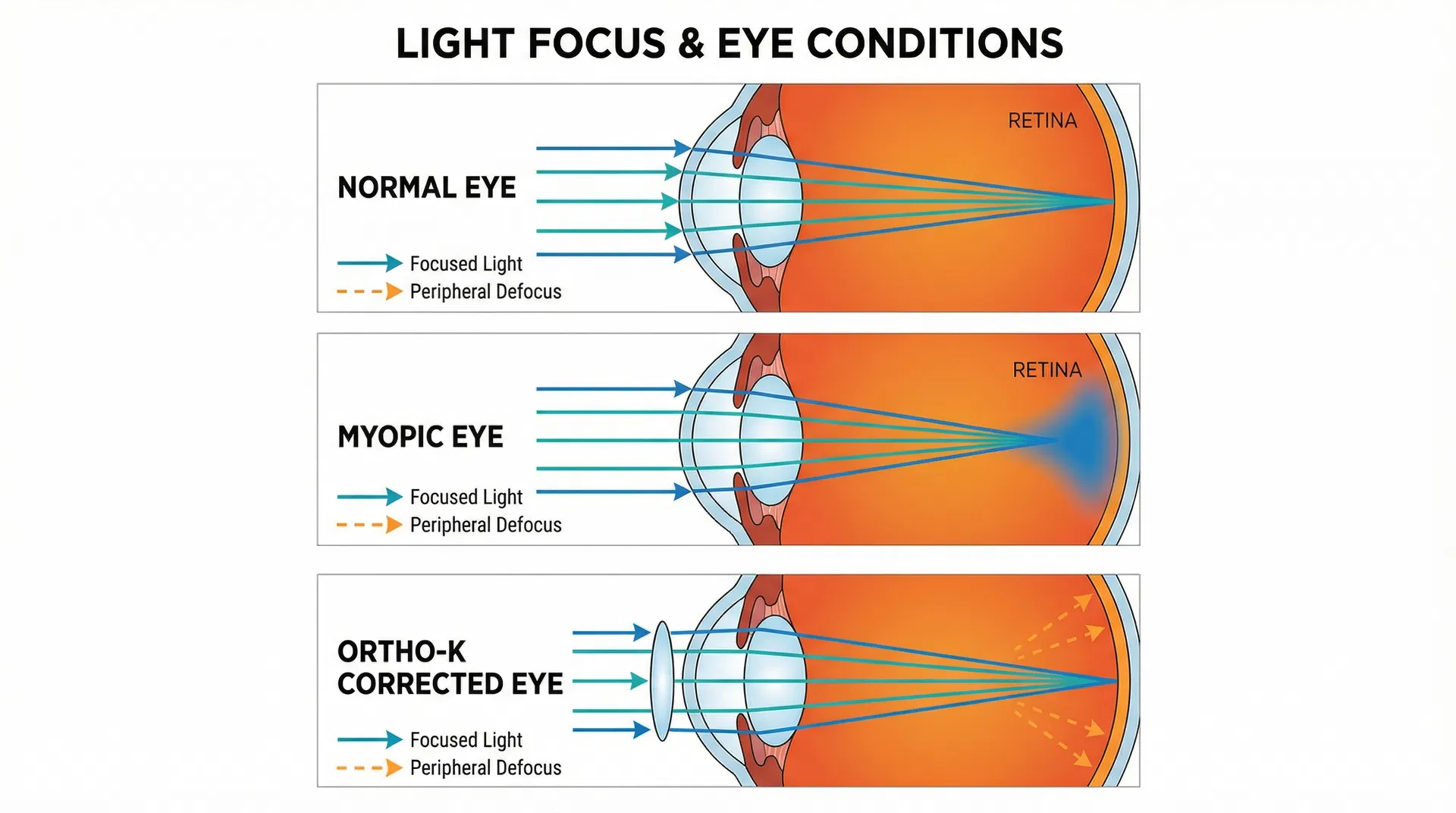
Now, imagine your child is wearing traditional single-vision glasses. These lenses do an excellent job of focusing light directly onto the fovea, giving them clear central vision. But here’s the problem: because of the eye's naturally curved shape, that same lens causes the light in the periphery to focus behind the retina. This is called hyperopic defocus. Think of it as a constant, subtle “growth” signal being sent to the eye. The eye, in its attempt to bring that blurry peripheral image into focus, grows longer. And a longer eye means higher myopia. It's a vicious cycle that we, as eye care professionals, are now learning how to break.
This image illustrates how single vision glasses can create hyperopic defocus in the periphery, while Ortho-K creates myopic defocus, which helps to control myopia progression.
The "Stop" Signal: How Ortho-K Changes the Game
This is where Ortho-K, or orthokeratology, comes in. I like to describe it to my patients and their parents here in Fayetteville as being like retainers for the eyes. These are specially designed, highly breathable lenses that are worn overnight while your child sleeps. They gently and safely reshape the cornea, the front surface of the eye. This reshaping not only corrects your child’s vision for the entire day, eliminating the need for glasses or daytime contacts, but it also fundamentally changes the way light focuses on the peripheral retina. Instead of focusing behind the retina, the light now focuses in front of it. This is called myopic defocus, and it sends a powerful “stop” signal to the eye, telling it to slow down its growth. It's a proactive approach to myopia, rather than a reactive one.
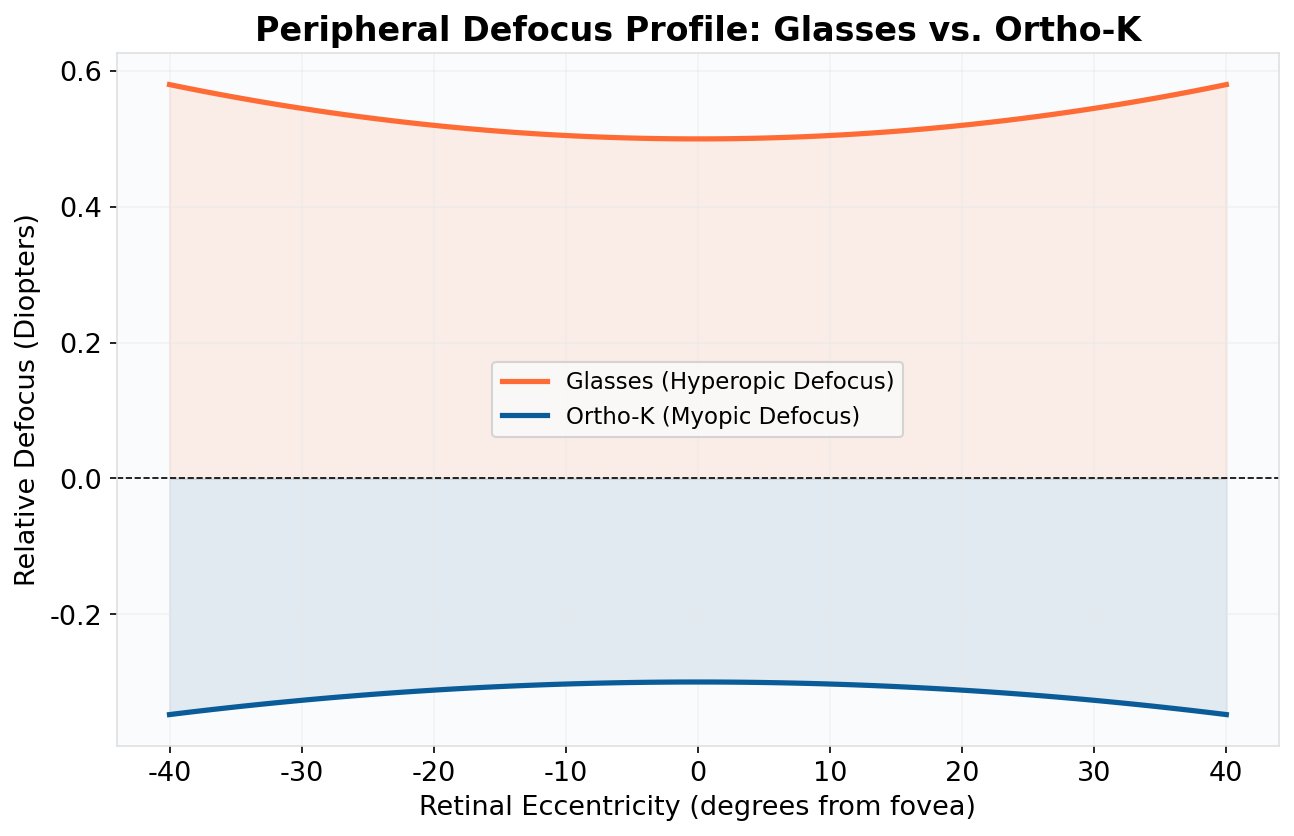
This chart shows the dramatic difference in the peripheral defocus profile between an eye corrected with glasses and an eye corrected with Ortho-K. The Ortho-K profile shows a significant myopic shift in the periphery, which is the key to its effectiveness in myopia control.
The Proof is in the Science
The theory of peripheral defocus isn’t just a hunch; it’s backed by a growing body of scientific evidence from around the world. Animal studies have been instrumental in proving this concept. In a landmark study, researchers at the National Institutes of Health (NIH) showed that monkeys fitted with lenses that created hyperopic defocus developed myopia, while those with lenses that created myopic defocus did not [1]. This was a pivotal moment in our understanding of how eye growth is regulated.
And it’s not just animals. Numerous clinical trials involving children have shown that Ortho-K is one of the most effective methods for myopia control. A study published in the prestigious journal of the American Academy of Ophthalmology (AAO) found that Ortho-K slowed the progression of myopia by an average of 50% compared to glasses [2]. Think about what that means for a child like Sam. Instead of his prescription doubling over a few years, we could cut that progression in half. That's a future with thinner glasses, or even no glasses at all, and a significantly lower risk of myopia-related eye diseases later in life.
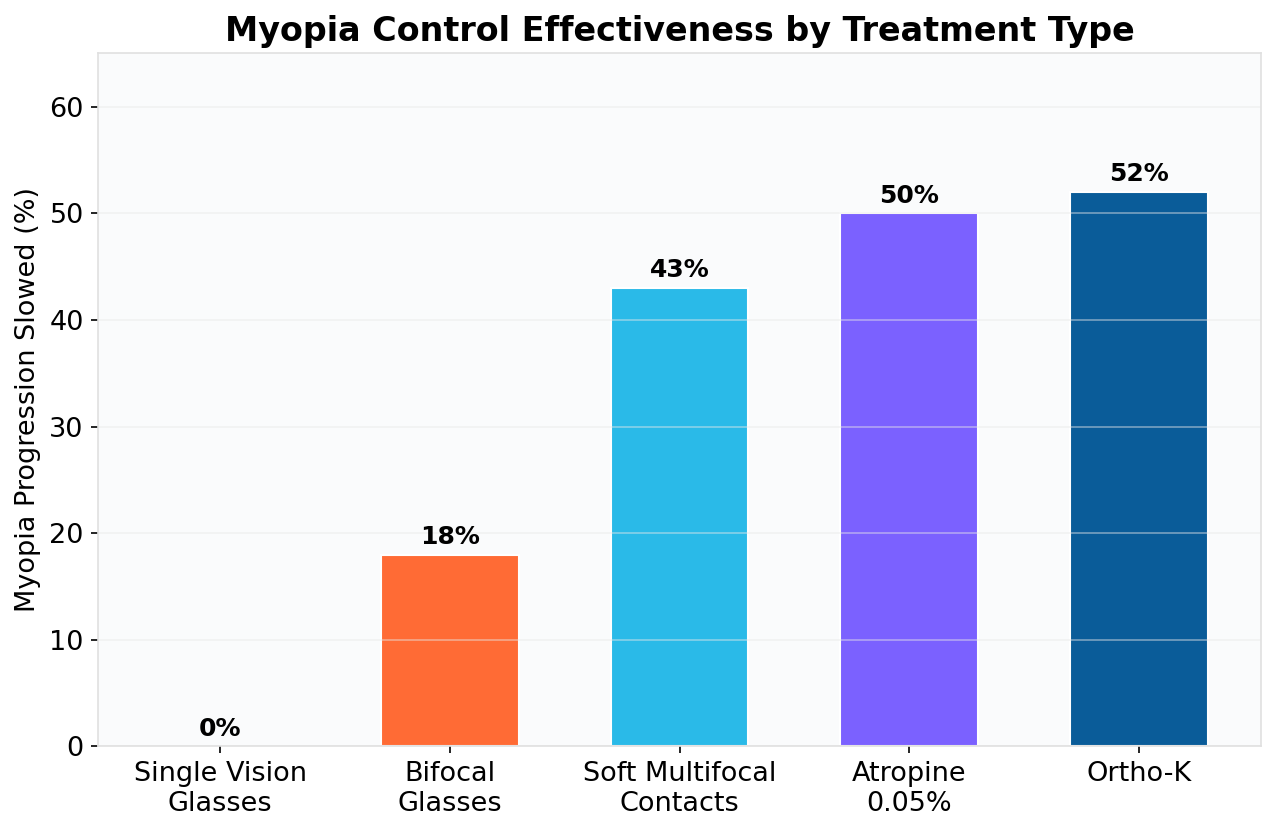
This chart compares the effectiveness of various myopia control treatments, with Ortho-K consistently showing one of the highest rates of success in slowing down myopia progression.
A Clearer Future for Your Child
As a parent, you want what’s best for your child. And when it comes to their vision, that means not just correcting their sight for today, but protecting it for the future. The rise of digital devices and changes in our children's lifestyles have led to a global myopia epidemic. Here in Cumberland County, I'm seeing more and more young children with myopia, and at earlier ages. This isn't just about stronger glasses; it's about a higher risk of serious eye diseases like glaucoma, retinal detachment, and myopic maculopathy later in life. By understanding the science of peripheral defocus, you can make an informed decision about your child’s myopia control journey. To learn more about whether your child is a candidate for sleepSEE®, take our candidacy quiz [blocked] or find a provider [blocked] near you.
How Different Corrections Affect Peripheral Defocus
| Correction Method | Central Vision | Peripheral Vision | Myopia Control Effect |
|---|---|---|---|
| Single Vision Glasses | Clear | Hyperopic Defocus (Grow Signal) | Minimal to None |
| Single Vision Contacts | Clear | Hyperopic Defocus (Grow Signal) | Minimal to None |
| sleepSEE® Ortho-K | Clear | Myopic Defocus (Stop Signal) | High |
| Multifocal Soft Contacts | Clear | Myopic Defocus (Stop Signal) | Moderate to High |
| Atropine Eye Drops | Clear | No direct effect on defocus | High (different mechanism) |
Frequently Asked Questions
Is Ortho-K safe for my child?
Yes, Ortho-K is a safe and effective method of vision correction for children. The lenses are made of a highly oxygen-permeable material, and when prescribed and cared for properly by a certified practitioner, the risk of complications is very low. As with any contact lens wear, proper hygiene and regular follow-up visits with your eye care provider are essential to ensure the health of your child's eyes.
How long does it take to see results with Ortho-K?
Most patients see a significant improvement in their vision after the very first night of wearing the lenses. It can take a week or two to reach the full, stable correction, but the results are often life-changing for children who have been dependent on glasses. The freedom from glasses during the day is a huge confidence booster for many kids.
Can my child play sports with Ortho-K?
Absolutely! In fact, Ortho-K is an excellent option for active children. Since the lenses are only worn at night, your child will have clear vision all day long without the hassle of glasses or daytime contacts. This is a huge advantage for kids who play sports, swim, or just enjoy being active without their glasses getting in the way. I've had patients who are competitive swimmers and gymnasts who have thrived with Ortho-K.
What is the difference between Ortho-K and multifocal contact lenses?
Both Ortho-K and multifocal soft contact lenses work by creating peripheral myopic defocus to slow down myopia progression. The main difference is how they are worn. Ortho-K lenses are worn overnight, while multifocal contacts are worn during the day. The choice between the two often comes down to lifestyle, prescription, and the specific needs of the child. I find that many parents in the Fort Liberty and Fayetteville area prefer the convenience of Ortho-K, as it eliminates the need to worry about contact lenses during the school day.
How much does sleepSEE® cost?
sleepSEE® myopia control is a specialty service not covered by insurance. However, we offer flexible payment options and accept HSA/FSA funds to make this life-changing treatment more accessible for families in the Fayetteville area. The initial investment in Ortho-K is higher than for glasses or regular contact lenses, but it's important to consider the long-term value. By slowing down the progression of myopia, you are investing in your child's future eye health and potentially reducing the lifetime costs associated with high myopia. For more information on pricing and financing, please visit our how it works [blocked] page or schedule a consultation with one of our providers.
Where can I learn more about myopia control?
Our blog [blocked] is a great resource for parents who want to learn more about myopia and the latest advancements in myopia control. We regularly post articles on a variety of topics, from the science behind myopia to practical tips for parents. We believe that an educated parent is the best advocate for their child's health.
Last reviewed: February 2026
References
[1] Smith III, E. L., et al. "Peripheral vision can influence eye growth and refractive development in infant monkeys." Investigative ophthalmology & visual science 46.11 (2005): 3965-3972.
[2] Cho, P., and S-W. Cheung. "Retardation of myopia in Orthokeratology (ROMIO) study: a 2-year randomized clinical trial." Investigative ophthalmology & visual science 53.11 (2012): 7077-7085.
Free Download: The Science Behind Ortho-K
A plain-language summary of 12 key clinical studies on orthokeratology efficacy.
- Summary of 12 peer-reviewed clinical studies
- Myopia progression rates with/without treatment
- Ortho-K vs. atropine vs. multifocal lenses
- FDA approval history and safety data
Ortho-K Research Summary
Science & Evidence — Free PDF
Dr. James Singletary, OD, FIAOMC
Dr. James Singletary, OD, FIAOMC is a contributor to the sleepSEE Insights blog, sharing expert knowledge on myopia progression, orthokeratology (Ortho-K) and myopia control.