- My Personal Journey with Myopia
- What is Ortho-K and How Does It Work?
- The Science of Corneal Reshaping
- Peripheral Myopic Defocus: The Key to Myopia Control
- Why Axial Length Matters
- Myopia Control Methods: A Comparison
- Ortho-K for Children in Fayetteville and Beyond
- Frequently Asked Questions
My Personal Journey with Myopia
As an optometrist who has dedicated my career to fighting myopia, I’ve seen firsthand the impact that nearsightedness can have on a person’s life. I’m Dr. James Singletary, and my passion for myopia control isn’t just professional; it’s personal. I’ve seen the frustration in the eyes of children who can’t see the board at school and the worry on the faces of parents in our Fayetteville community as their child’s prescription gets stronger every year. That’s why I’m so excited to share with you the science behind one of the most effective tools we have to combat childhood myopia: Orthokeratology, or Ortho-K.
Here in Cumberland County, we’re seeing a growing number of children developing myopia at a young age. This isn’t just a local trend; it’s a global one. But the good news is, we’re no longer limited to simply correcting vision with stronger and stronger glasses. With treatments like Ortho-K, we can actively work to slow down the progression of myopia, protecting your child’s vision for years to come. In this article, we’ll take a deep dive into the science of how Ortho-K works its magic.
What is Ortho-K and How Does It Work?
Imagine a contact lens that you only wear at night, and when you wake up, you can see clearly all day long without glasses or contacts. It might sound like science fiction, but that’s exactly what Ortho-K is. These are specially designed, rigid, gas-permeable contact lenses that gently reshape the cornea—the clear front surface of the eye—while you sleep. This reshaping is temporary, so the lenses must be worn each night to maintain the effect.
The primary goal of Ortho-K has traditionally been to correct refractive errors like myopia. However, in recent years, we’ve discovered a remarkable secondary benefit: it can significantly slow down the progression of myopia in children. This has been a game-changer for how we approach childhood vision care, especially for families here in the Fort Liberty area who want the best for their children’s long-term eye health.
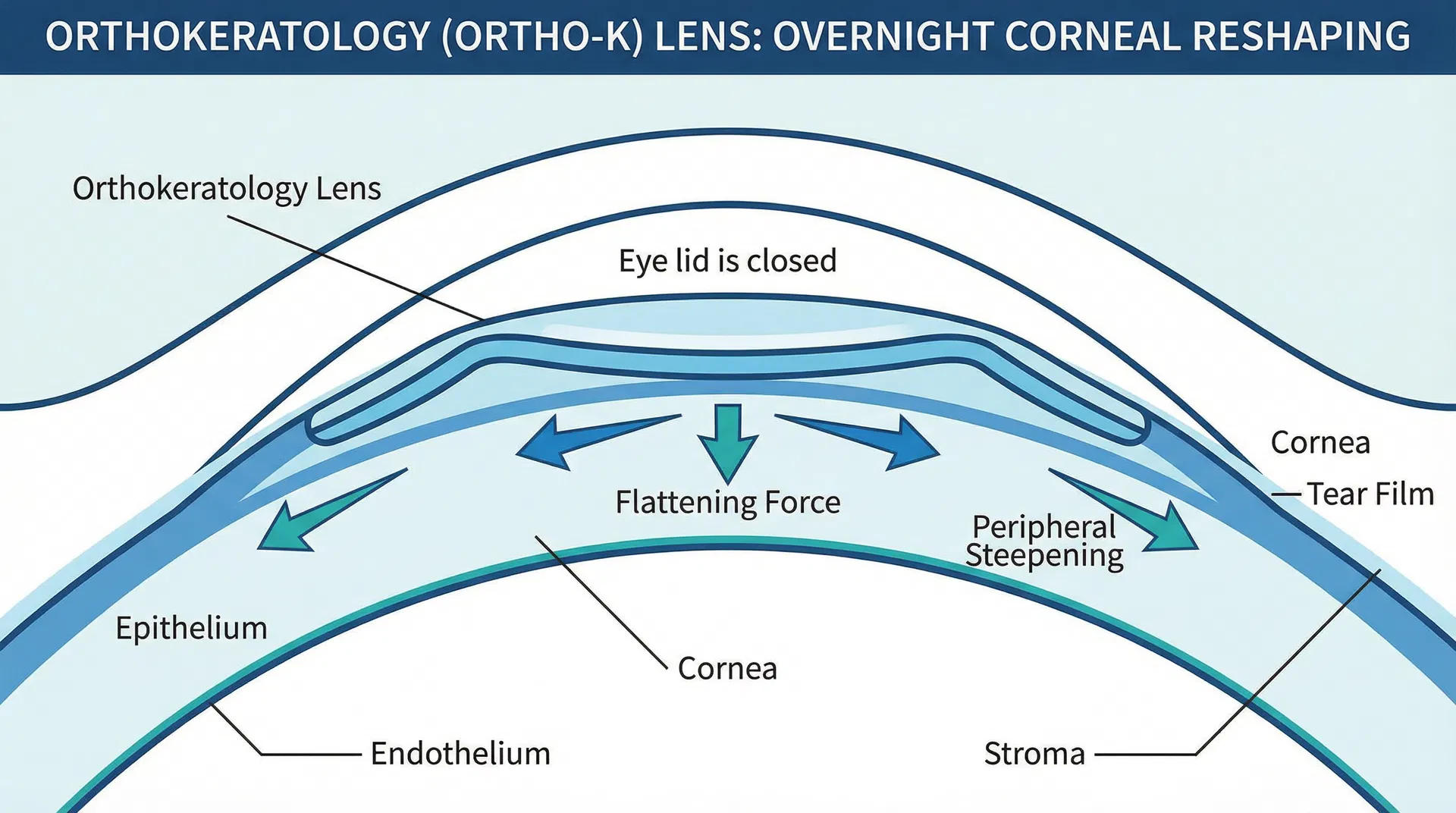
This diagram illustrates how the sleepSEE® lens gently reshapes the cornea overnight, correcting vision and creating the peripheral myopic defocus that helps slow down myopia progression.
The Science of Corneal Reshaping
The magic of Ortho-K lies in the precise and controlled reshaping of the cornea. The lenses are designed with a specific curvature that creates gentle hydraulic forces on the tear film between the lens and the cornea. These forces cause the central part of the cornea to flatten slightly, which corrects the refractive error that causes myopia. Think of it like a mold that gently shapes the cornea into the ideal curvature for clear vision.
This process is incredibly precise. Before we even design the lenses, we use a topographer to create a detailed map of your child’s cornea. This allows us to create a custom lens that is perfectly suited to their unique eye shape. The result is a lens that is not only effective but also comfortable to wear throughout the night.
Peripheral Myopic Defocus: The Key to Myopia Control
While the central corneal flattening is what corrects vision, the real key to Ortho-K’s myopia control effect is what happens in the periphery of the retina. When a child with myopia wears traditional glasses or contact lenses, the central vision is focused perfectly on the retina. However, in the periphery, the light is often focused behind the retina. This is called peripheral hyperopic defocus, and we now believe that it acts as a signal for the eye to grow longer, which in turn worsens myopia.
Ortho-K lenses, on the other hand, create a different kind of peripheral focus. Because of the way they reshape the cornea, they cause the peripheral light rays to focus in front of the retina. This is called peripheral myopic defocus, and it’s a crucial difference. This myopic defocus is thought to send a signal to the eye to slow down its growth. The LORIC and ROMIO studies, two landmark studies in the field of myopia control, have provided strong evidence to support this theory. [1] [2]
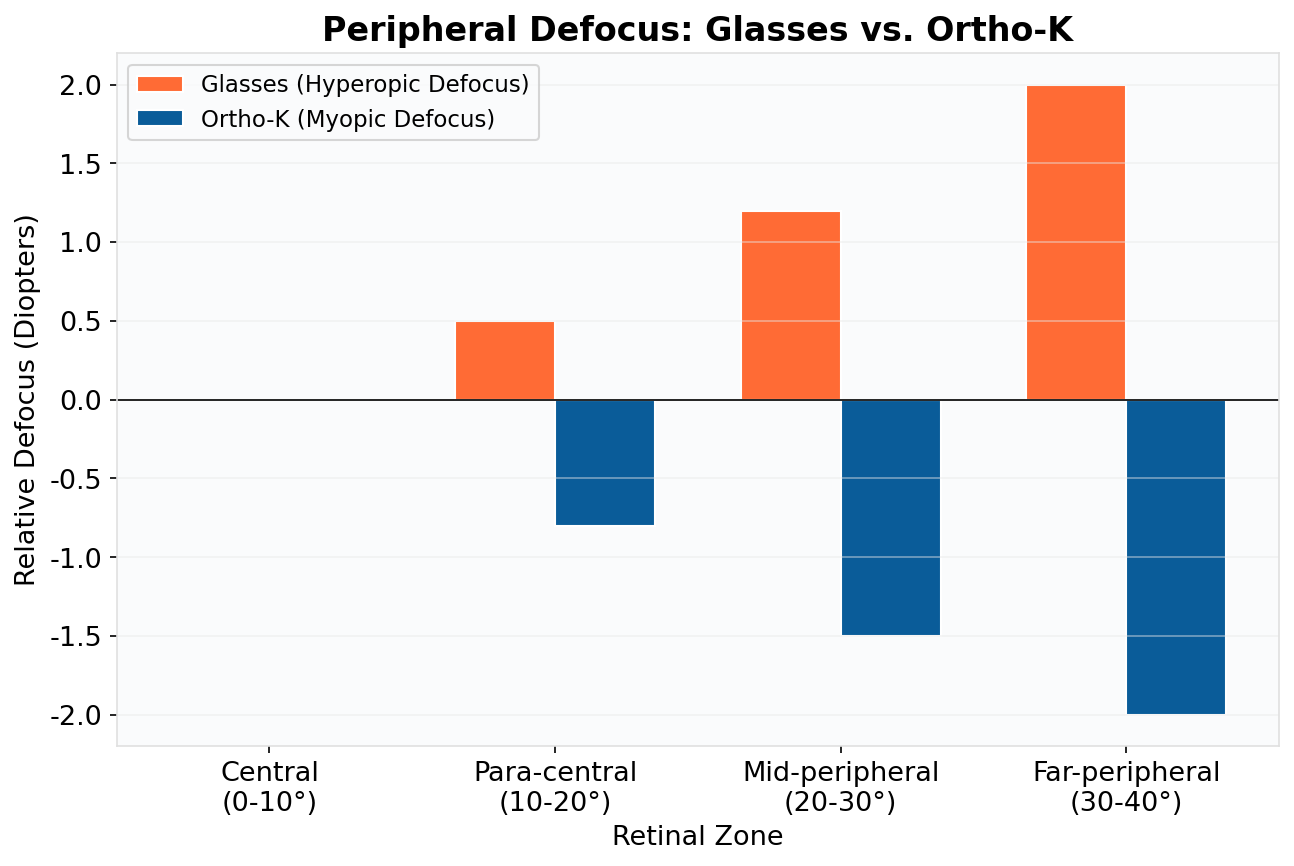
This chart shows the difference in peripheral defocus between traditional glasses and Ortho-K. The myopic defocus created by Ortho-K is a key factor in its ability to slow down myopia progression.
Why Axial Length Matters
So, why is it so important to slow down the eye’s growth? The answer lies in the axial length of the eye. The axial length is the distance from the front of the eye to the back. In myopic eyes, this length is longer than it should be, which is what causes distant objects to appear blurry. The goal of myopia control is to slow down the rate of axial elongation.
By slowing down the growth of the eye, we can reduce the risk of your child developing high myopia, which is associated with a number of serious eye conditions later in life, such as retinal detachment, glaucoma, and myopic maculopathy. That’s why we meticulously measure the axial length of our young patients’ eyes at every visit. It’s the most accurate way to track the progression of their myopia and the effectiveness of their treatment.
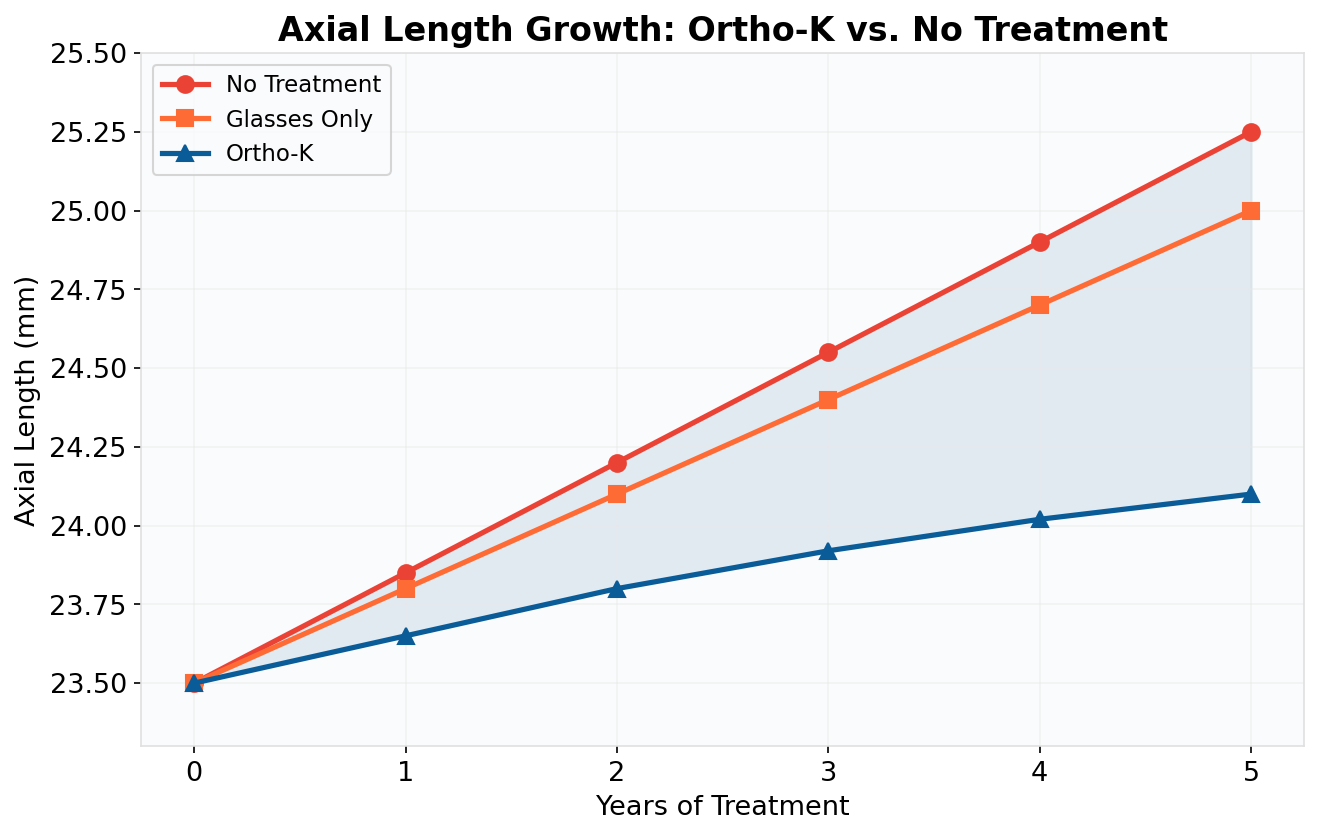
This chart demonstrates the significant difference in axial length growth between children undergoing Ortho-K treatment and those with no treatment. This is why we say that Ortho-K can help protect your child’s vision for a lifetime.
Myopia Control Methods: A Comparison
Ortho-K is just one of several effective methods for myopia control. To help you understand the options, here’s a comparison of the most common treatments:
| Treatment | How it Works | Effectiveness | Best For |
|---|---|---|---|
| Ortho-K | Reshapes the cornea overnight with special contact lenses. | High (up to 50% reduction in progression) | Active children who don’t want to wear glasses or contacts during the day. |
| MiSight® 1 day | Daily disposable soft contact lenses with special zones to create peripheral myopic defocus. | High (up to 59% reduction in progression) | Children who prefer the convenience of a daily disposable lens. |
| Atropine Eye Drops | Low-dose eye drops used daily to relax the eye’s focusing mechanism. | Moderate to High (depending on concentration) | Children who are not ready for contact lenses or as an adjunct to other treatments. |
| Bifocal/Multifocal Glasses | Special glasses with different zones to create peripheral myopic defocus. | Moderate | Younger children or those who cannot wear contact lenses. |
It’s important to note that the best treatment for your child will depend on a number of factors, including their age, prescription, and lifestyle. That’s why a comprehensive eye exam and a discussion with an experienced myopia control specialist are so important. You can learn more about the different options on our blog [blocked] or by taking our candidacy quiz [blocked].
Ortho-K for Children in Fayetteville and Beyond
As a father and an optometrist, I’m committed to providing the best possible care for the children in our community. I’ve seen the life-changing impact that Ortho-K can have, and I’m proud to be one of the leading providers of this technology in the Fayetteville and Fort Liberty area. If you’re concerned about your child’s vision, I encourage you to schedule a consultation. We can discuss whether Ortho-K is the right choice for your child and answer any questions you may have.
We understand that specialty services like sleepSEE® myopia control are not covered by insurance. That’s why we offer flexible payment options and accept HSA/FSA funds to make this treatment more accessible for families. Your child’s vision is too important to wait.
Frequently Asked Questions
Is Ortho-K safe for children?
Yes, Ortho-K is very safe for children. The lenses are made of a highly oxygen-permeable material, and when prescribed and cared for properly, the risk of complications is very low. In fact, numerous studies have demonstrated the safety and efficacy of Ortho-K in children. [3]
How long does it take to see results with Ortho-K?
Most patients see a significant improvement in their vision after just one night of wearing the lenses. It can take a week or two to reach the full effect, but the results are typically quite rapid.
What happens if my child stops wearing the lenses?
If your child stops wearing the lenses, their cornea will gradually return to its original shape, and their myopia will return. The myopia control effects will also cease. That’s why it’s important to be consistent with wearing the lenses every night.
Where can I find a provider for Ortho-K?
You can find a qualified Ortho-K provider in your area by visiting our find-a-provider [blocked] page. It’s important to choose a provider who has experience and expertise in fitting these specialized lenses.
How does Ortho-K work?
To learn more about the specifics of how Ortho-K works, please visit our how-it-works [blocked] page for a detailed explanation.
Last reviewed: February 2026
References
[1] Cho, P., & Cheung, S. W. (2012). Retardation of myopia in Orthokeratology (ROMIO) study: a 2-year randomized clinical trial. Investigative ophthalmology & visual science, 53(11), 7077–7085. https://doi.org/10.1167/iovs.12-10565
[2] Charm, J., & Cho, P. (2013). High myopia-partial reduction ortho-k: a 2-year randomized study. Optometry and vision science : official publication of the American Academy of Optometry, 90(6), 530–539. https://doi.org/10.1097/OPX.0b013e318293657d
[3] Liu, Y. M., & Xie, P. (2016). The Safety of Orthokeratology-A Systematic Review. Eye & contact lens, 42(1), 35–42. https://doi.org/10.1097/ICL.0000000000000219
Myopia Control Mechanisms Compared
How the leading myopia control treatments work at the biological level.
| Treatment | Primary Mechanism | Peripheral Defocus | Axial Length Reduction | Evidence Level |
|---|---|---|---|---|
| Ortho-K | Corneal reshaping | Myopic periphery | ★★★★☆ Strong | Level 1 RCTs |
| Low-Dose Atropine | Muscarinic antagonist | No | ★★★★★ Strongest | Level 1 RCTs |
| Multifocal Soft Lenses | Optical defocus | Partial | ★★★☆☆ Moderate | Level 1 RCTs |
| Outdoor Time | Dopamine release | No | ★★☆☆☆ Preventive | Observational |
| Standard Glasses | Refractive correction only | No | No | N/A |
Evidence levels based on GRADE criteria. RCT = Randomized Controlled Trial. Combination therapy (ortho-k + atropine) may produce additive effects.
Read the Clinical StudiesFree Download: The Science Behind Ortho-K
A plain-language summary of 12 key clinical studies on orthokeratology efficacy.
- Summary of 12 peer-reviewed clinical studies
- Myopia progression rates with/without treatment
- Ortho-K vs. atropine vs. multifocal lenses
- FDA approval history and safety data
Ortho-K Research Summary
Science & Evidence — Free PDF
Dr. James Singletary, OD, FIAOMC
Dr. James Singletary, OD, FIAOMC is a contributor to the sleepSEE Insights blog, sharing expert knowledge on myopia progression, orthokeratology (Ortho-K) and myopia control.