Last reviewed: February 2026 by the sleepSEE Clinical Advisory Team
In This Article
- Night One: The First Wear
- Days 1–3: Early Adaptation
- Days 4–7: Vision Stabilizing
- Week 2: Building the Routine
- Weeks 3–4: Full Results
- The Daily Care Routine
- Common Questions in the First Month
- Your Follow-Up Schedule
- What Parents in Fayetteville Are Experiencing
- Frequently Asked Questions
- The Bottom Line
The first night is always the one parents worry about most.
Will my child be able to sleep with lenses in? What if they fall out? What if the vision isn't clear in the morning?
I've heard every version of this question at Eye Medics Optometry in Fayetteville. And I always give the same answer: the first 30 days are a learning curve, not a test. Most families are surprised by how quickly it becomes routine — and how dramatically their child's mornings change.
Here's exactly what to expect, week by week.
Night One: The First Wear
Your child's first night with sleepSEE lenses will feel different. That's normal. The lenses are rigid gas-permeable, which means they feel more substantial than soft lenses. Most children describe a mild awareness of the lens — not pain, just presence.
A few things to know before that first night:
- Insertion takes about 5 minutes once learned. Your provider will walk you through the technique at the fitting appointment.
- The lenses should be worn for at least 6–8 hours to allow the cornea to reshape fully.
- Some tearing or mild redness is normal on the first night. The eye is adapting.
- Do not panic if vision is slightly blurry the next morning. The cornea needs multiple nights to hold the new shape consistently.
That first morning of clear vision — no glasses needed — is a moment most families remember.
Days 1–3: Early Adaptation
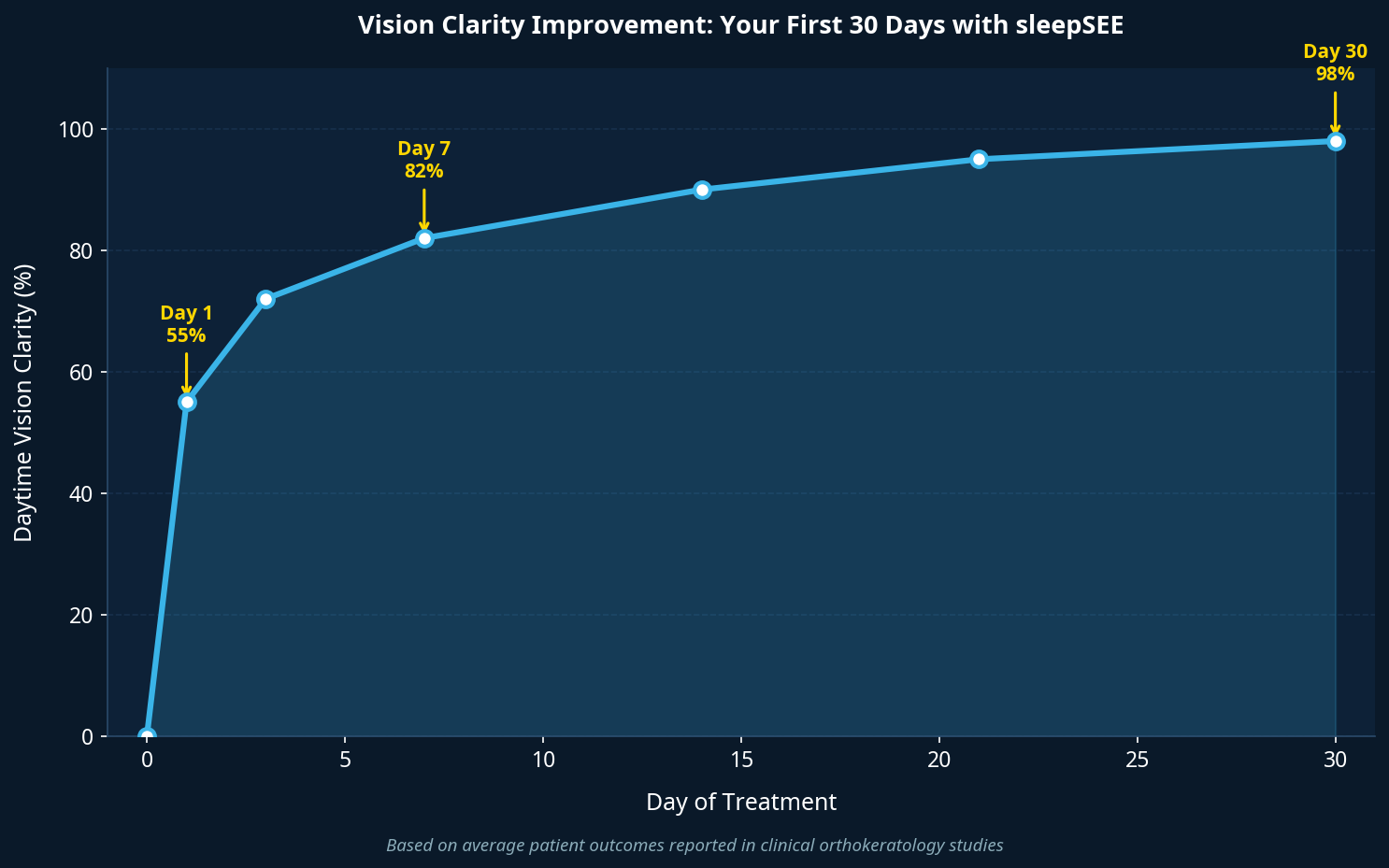
Most children see noticeably improved vision after the first night — often around 55–70% of their target correction. It won't be perfect yet. That's expected.
During these early days:
- Vision may fluctuate throughout the day. It's typically clearest in the morning and may soften slightly by afternoon.
- Halos or starbursts around lights at night are common, especially when driving (for older teens). These usually resolve within 2–4 weeks.
- Mild lens awareness during insertion and removal is normal. It fades quickly as the routine becomes familiar.
The most important thing in these first days? Consistency. Wear the lenses every night. Skipping nights during the adaptation phase slows the process significantly.
Days 4–7: Vision Stabilizing
By the end of the first week, most children are seeing 80–85% of their target correction. Many are already going to school, playing sports, and going through their day without glasses.
This is the week when the routine starts to feel natural. Insertion and removal become faster. The morning check — "Can I see the clock?" — becomes a ritual.
At the one-week follow-up appointment, your provider will:
- Check corneal health and lens fit
- Measure your child's daytime vision
- Make any adjustments to the lens parameters if needed
- Answer questions about the routine
This visit is important. Don't skip it.
Week 2: Building the Routine
Week two is when most families hit their stride. The lenses go in without much thought. Vision is consistently clear. The morning glasses search is a memory.
A few things to watch for during week two:
- Dry eyes in the morning — some children experience mild dryness when removing lenses. Rewetting drops (preservative-free) can help. Ask your provider which drops are compatible with your lens type.
- Lens care shortcuts — it's tempting to rush the cleaning routine once it feels routine. Don't. Proper cleaning prevents deposits that reduce lens performance and increase infection risk.
- Vision at the end of the day — if your child's vision is noticeably blurry by late afternoon, mention it at the next follow-up. It may indicate the lenses need a minor adjustment.
Weeks 3–4: Full Results
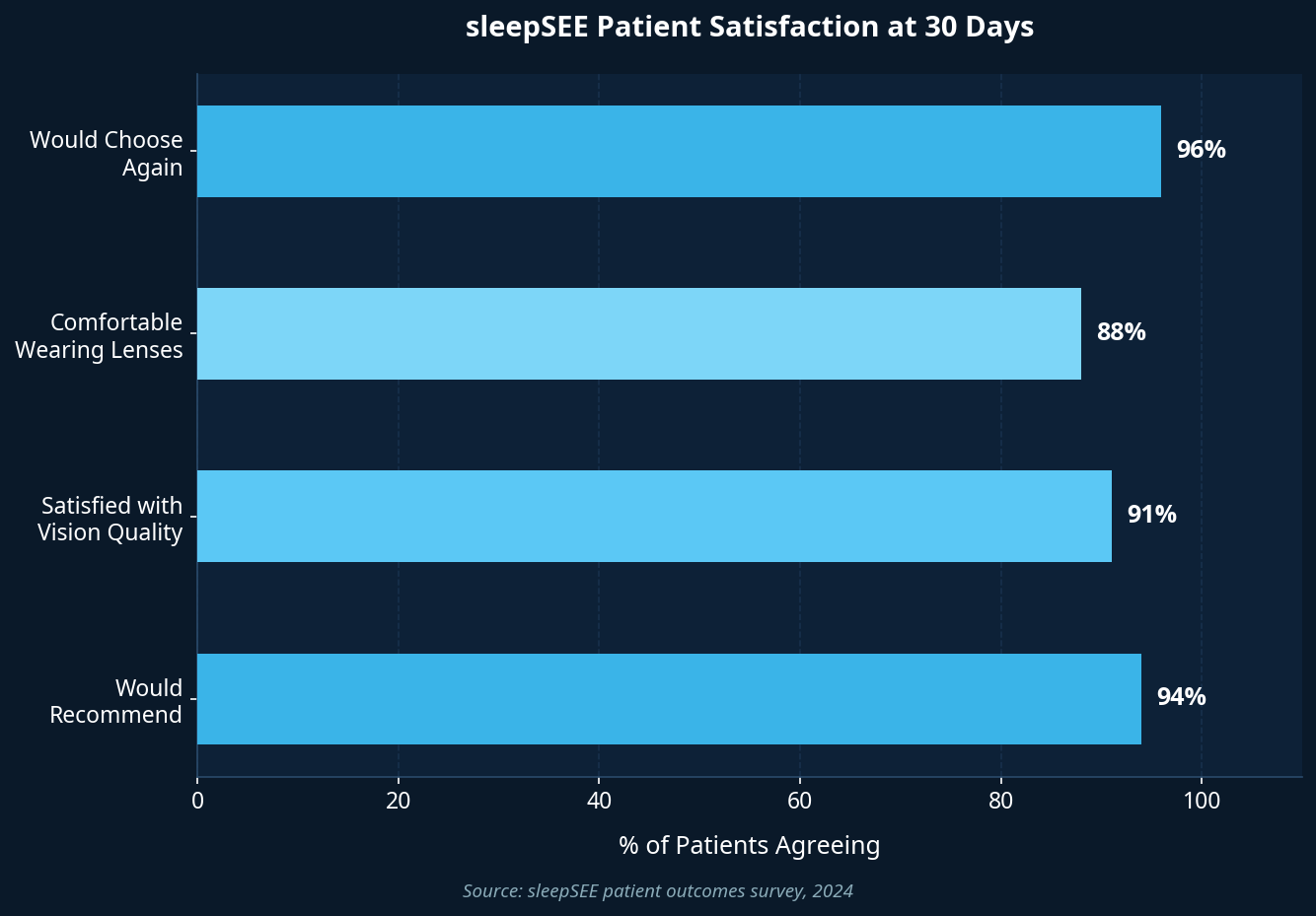
By the end of the first month, most children have reached their full target correction — typically 95–98% of their prescription addressed. Vision is stable, clear, and consistent throughout the day. [1]
This is also when the myopia control benefit kicks in fully. The corneal reshaping that happens every night is actively slowing the axial elongation that drives myopia progression. Studies show ortho-k reduces progression by 36–56% compared to glasses alone. [2]
The Daily Care Routine
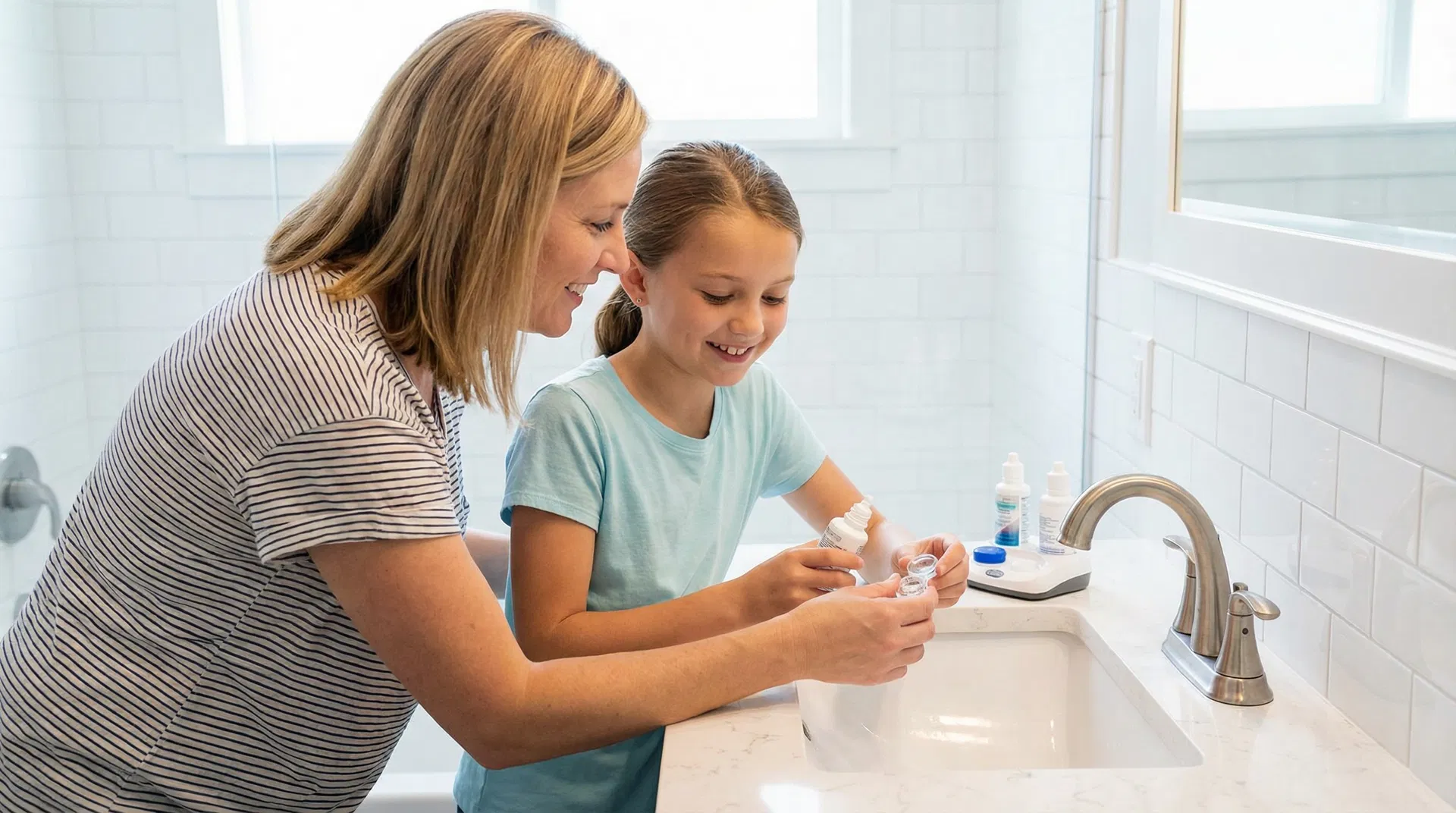
Consistency in lens care is what keeps ortho-k safe and effective. Here's the routine your provider will teach you:
| Step | When | What to Do |
|---|---|---|
| Wash hands | Before any lens handling | Soap and water, dry with lint-free towel |
| Insert lenses | Bedtime | Fill lens with 1–2 drops of rewetting solution, place on eye |
| Remove lenses | Morning | Use suction cup tool or finger technique as taught |
| Rinse lenses | After removal | Rinse with saline or multipurpose solution — never tap water |
| Clean lenses | After rinsing | Rub gently with cleaning solution for 20 seconds per lens |
| Store lenses | After cleaning | Fill case with fresh solution — never reuse old solution |
| Replace case | Weekly | Lens cases harbor bacteria — replace regularly |
Never use tap water on ortho-k lenses. Tap water can harbor Acanthamoeba, an organism that causes a serious corneal infection. This is the most important safety rule in lens care.
Common Questions in the First Month
"My child says the lens feels uncomfortable when inserting. Is that normal?" Yes, for the first 1–2 weeks. The sensation typically fades as the eye adapts. If there is pain (not just awareness), remove the lens and contact your provider.
"The vision seems great in the morning but gets blurry by 3 PM. What's happening?" This is common in the first few weeks and usually resolves as the cornea adapts. If it persists beyond week 3, your provider may adjust the lens design.
"My child lost a lens. What do we do?" Contact your provider. A replacement lens can usually be ordered within a few days. In the meantime, your child may need to wear glasses temporarily.
"Can my child swim or play sports with the lenses in?" No — lenses are worn only during sleep. During the day, your child is lens-free. Swimming and sports are unrestricted.
Your Follow-Up Schedule
| Visit | Timing | Purpose |
|---|---|---|
| 1-Day Check | Morning after first wear | Confirm fit, check corneal response |
| 1-Week Check | After 7 nights | Assess vision, adjust parameters if needed |
| 1-Month Check | After 30 nights | Confirm full correction, evaluate myopia control |
| Ongoing | Every 6 months | Monitor myopia progression, replace lenses annually |
At Eye Medics Optometry in Fayetteville, we schedule all follow-up visits at the time of fitting so nothing falls through the cracks. Families at Fort Liberty and throughout Cumberland County can also reach us by phone or through the patient portal for any questions between visits.
What Parents in Fayetteville Are Experiencing
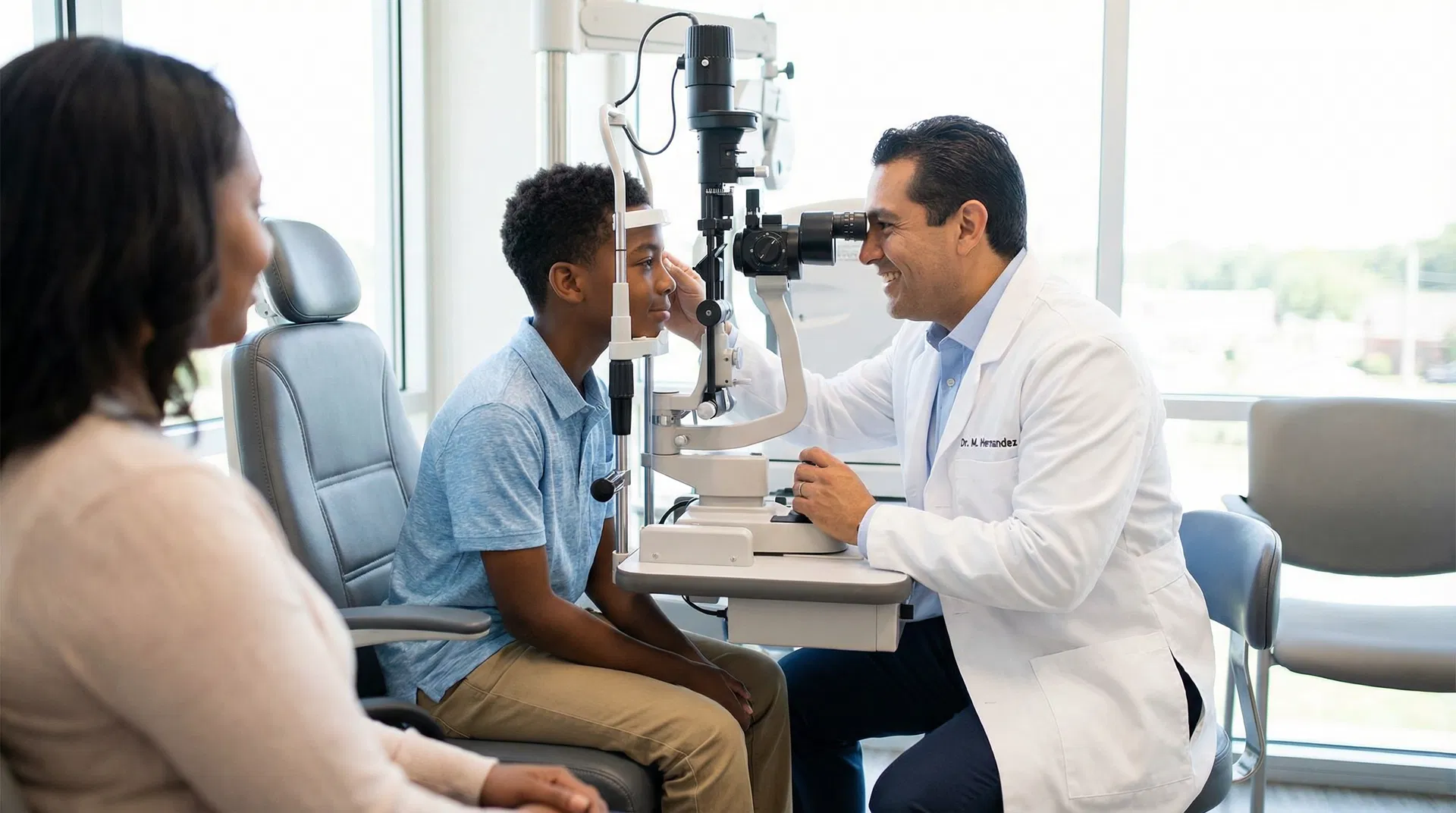
Families across Fayetteville, Hope Mills, Spring Lake, and the Fort Liberty community have shared their first-month experiences with us. A few themes come up consistently:
The morning moment. Almost every family mentions the first morning their child woke up and could read the clock across the room without glasses. It's a small thing. It's also not a small thing at all.
The sports difference. For children in Cumberland County youth sports leagues — soccer, basketball, baseball — the freedom from glasses is transformative. No more fogged lenses in the rain. No more broken frames on the field.
The routine becoming invisible. By week three, most parents tell us they barely think about the lenses anymore. It's just part of the bedtime routine, like brushing teeth.
Military family flexibility. For families at Fort Liberty who may PCS in the next year or two, knowing that sleepSEE providers are nationwide — and that lens parameters transfer — removes a major concern about starting a long-term treatment.
Frequently Asked Questions
Q: Does insurance cover sleepSEE? sleepSEE® myopia control is a specialty service not covered by insurance. Flexible payment options and HSA/FSA funds are accepted.
Q: What if my child gets sick and can't wear the lenses for a few nights? The cornea will gradually return toward its original shape. Vision may become slightly blurry after 2–3 nights without lenses. Resume wearing as soon as your child is well. No harm is done by a brief pause.
Q: How long do the lenses last? Most ortho-k lenses are replaced annually, though some last 18–24 months with proper care. Your provider will assess lens condition at each follow-up.
Q: Can my child wear the lenses if they have a red or irritated eye? No. Remove lenses immediately if the eye is red, painful, or producing discharge, and contact your provider. Never wear lenses over an irritated eye.
Q: What's the difference between sleepSEE and other ortho-k brands? sleepSEE uses custom-designed lenses fitted by certified providers who specialize in myopia control. The difference is in the fitting expertise and the ongoing monitoring protocol — not just the lens itself.
Q: When will we know if the myopia control is working? Myopia control is measured at each annual exam by comparing the current prescription and axial length to baseline. Most families see measurably slower progression within the first year.
The Bottom Line
The first 30 days with sleepSEE are a transition — from glasses-dependent to glasses-free, from worrying about progression to actively controlling it. The learning curve is real, but it's short. Most families are fully comfortable with the routine by week two.
The results speak for themselves: clearer mornings, more freedom during the day, and a measurable slowdown in myopia progression that compounds year after year.
If your child is just starting out, trust the process. The first 30 days are the hardest. Everything after that gets easier.
Find a sleepSEE Provider Near You [blocked] | Check Your Child's Candidacy [blocked]
Last reviewed: February 2026 | Sources: [1] PMC — Orthokeratology Clinical Outcomes | [2] JAMA Ophthalmology — Myopia Control Interventions
Free Download: Myopia Risk Checklist for Parents
Is your child's vision at risk? Get the 10-point checklist used by ortho-k specialists.
- 10 warning signs myopia is progressing
- Questions to ask your eye doctor
- How to evaluate ortho-k candidacy
- What to expect in the first 30 days
Myopia Risk Checklist
For Parents — Free PDF Guide
Dr. James Singletary, OD, FIAOMC
Dr. James Singletary, OD, FIAOMC is a contributor to the sleepSEE Insights blog, sharing expert knowledge on myopia progression, orthokeratology (Ortho-K) and myopia control.