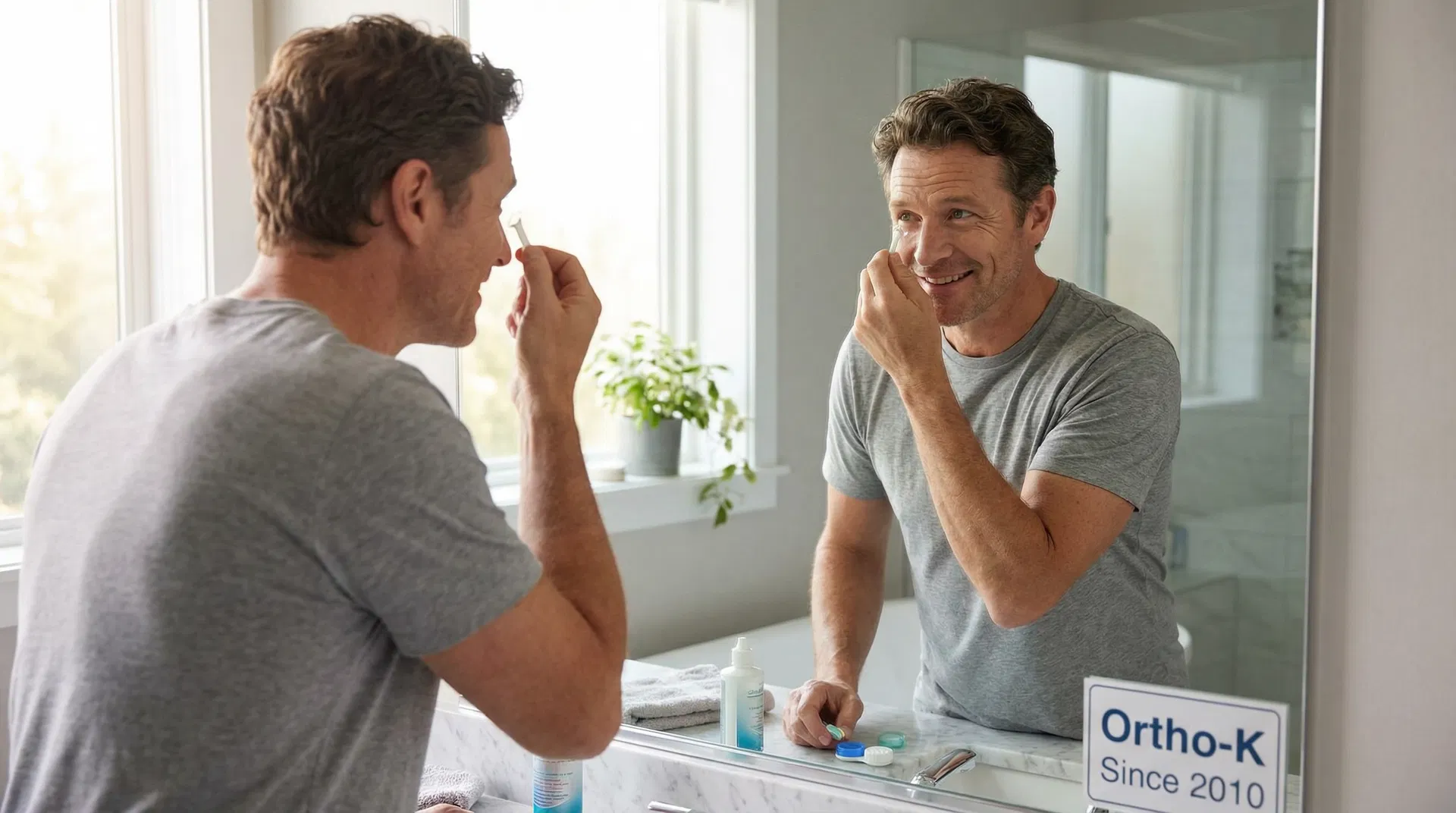
One of the questions I hear almost every week in my Fayetteville office is, "Dr. Singletary, I like the idea of sleepSEE®, but what happens if I stop wearing the lenses? Am I stuck with it forever?"
It’s a great question. You’re thinking ahead, considering all the angles, and I appreciate that. Many of our patients are from military families at Fort Liberty, so they’re used to thinking about changing circumstances. Life happens, right? You might move, your prescription might change, or you might just want to try something different down the road.
Here's the thing: with Ortho-K, you’re not locked into anything. And that’s not a drawback; it’s one of its biggest strengths. Let me explain why that matters.
Table of Contents
- What is sleepSEE® Ortho-K?
- The Reversibility Feature: What Happens When You Stop?
- Your Vision After Stopping: A Day-by-Day Timeline
- Ortho-K vs. Surgical Options: A Flexibility Comparison
- Is It Safe to Take a Break from Ortho-K?
- Getting Back on Track: Resuming Your sleepSEE® Lenses
- Why Flexibility is a Game-Changer
- A Note on Insurance and Payment
- Frequently Asked Questions
What is sleepSEE® Ortho-K?
First, a quick refresher. sleepSEE® is the brand of orthokeratology, or Ortho-K, that we specialize in here at our practice. Think of it as braces for your eyes. You wear custom-designed rigid lenses while you sleep, and they gently reshape the front surface of your eye, the cornea. You take them out in the morning and—voila!—clear vision all day long without glasses or daytime contacts. It’s a fantastic option for both kids and adults, and it’s a cornerstone of our Myopia Control [blocked] program.
But unlike a surgical procedure, nothing is permanently altered. The process is completely reversible.
The Reversibility Feature: What Happens When You Stop?
So, you’ve decided to take a break. Maybe you’re going on an extended trip and don’t want to bring your lenses, or perhaps you’re just curious. What happens next?
Simply put, your eye will gradually return to its original shape. The gentle pressure from the sleepSEE® lenses is what holds the new shape, so without that nightly molding, the cornea’s natural elasticity takes over. Your prescription will slowly revert to what it was before you started Ortho-K.
This isn’t a failure of the treatment. It’s a built-in safety feature. It gives you total control over your vision correction. You’re never stuck. For my patients here in Cumberland County, that flexibility is a huge plus. Life is unpredictable, and having options that can adapt with you is a modern necessity.

Your Vision After Stopping: A Day-by-Day Timeline
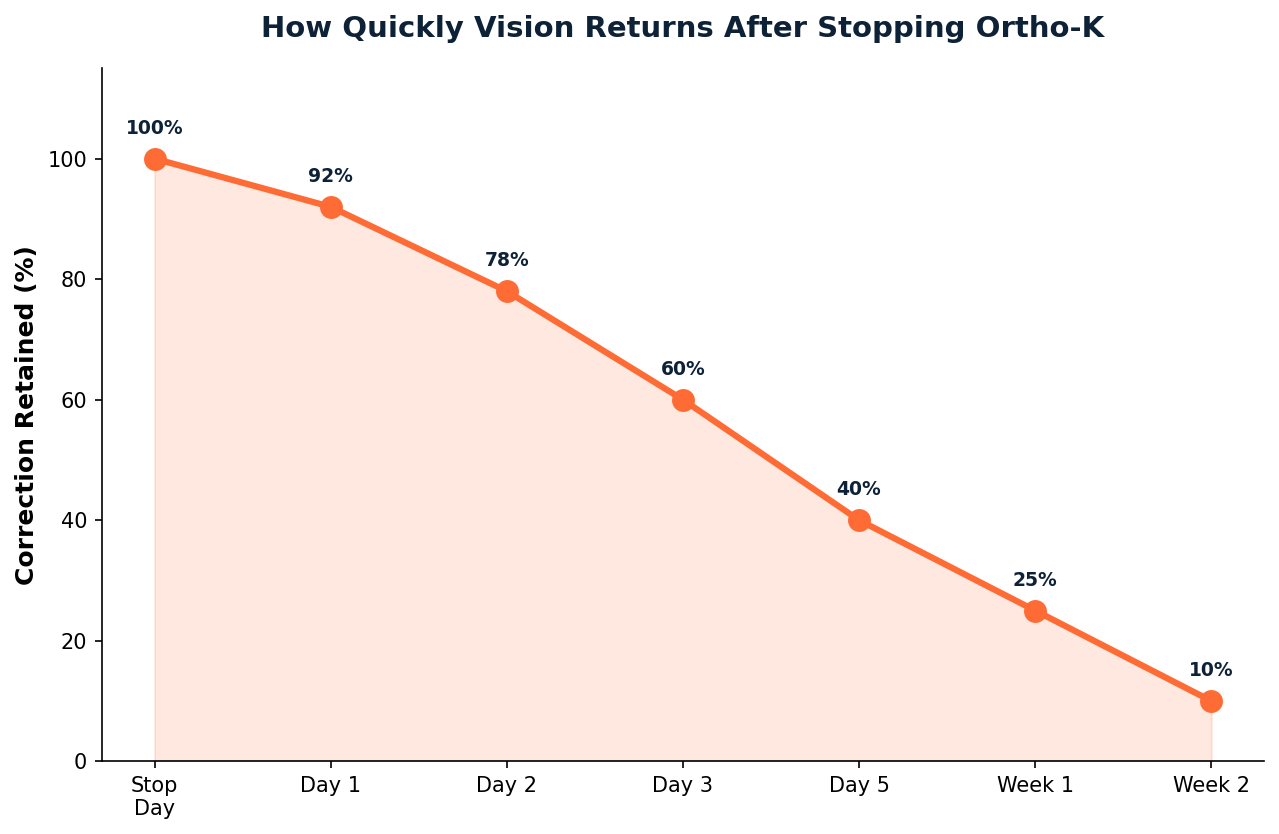
Your vision won't just snap back overnight. The return to your old prescription is a gradual process. While it varies from person to person based on the original prescription and how long you’ve been wearing the lenses, we see a pretty consistent pattern.
- Days 1-3: You’ll likely still have pretty good vision, especially in the first 24-48 hours. You might start to notice a slight blurriness toward the end of the day. Most people can still drive and function normally without glasses.
- Days 4-7: The blur will become more noticeable. Your original nearsightedness and astigmatism will start to creep back in. You’ll probably need to wear your old glasses for certain tasks, like driving at night.
- Weeks 1-2: By this point, your cornea has returned significantly toward its original shape. Your vision will be close to your pre-treatment prescription. You'll need to wear your backup glasses or contacts full-time.
- Weeks 2-4: For most people, the cornea will have fully reverted to its natural shape within a month. It’s as if you never wore the lenses at all.
Here’s a visual that shows what that regression typically looks like:
Ortho-K vs. Surgical Options: A Flexibility Comparison
This is where the difference between Ortho-K and a procedure like LASIK becomes crystal clear. When I consult with patients, especially younger adults who are students or just starting their careers, this is a major point of discussion.
| Feature | sleepSEE® Ortho-K | LASIK Surgery |
|---|---|---|
| Reversibility | Fully Reversible. Stop wearing the lenses, and your eye returns to its original state. | Permanent. A laser removes corneal tissue, an irreversible change. |
| Adaptability | Highly Adaptable. We can adjust the lens design if your prescription changes over time. | Limited. Future changes may require another surgery (enhancement), which isn't always possible. |
| Age Requirement | No Age Limit. Safe for kids and adults. | Typically 18-21+. Requires a stable prescription for several years. |
| Risk Profile | Low Risk. The main risks are related to contact lens hygiene and are manageable. [1] | Higher Risk. Involves surgical risks like dry eye, glare, and flap complications. [2] |
| Best For | Those who want freedom from glasses but also want flexibility and a non-surgical approach. | Those who are certain about their choice and accept the permanence and surgical risks. |
For many, the idea of a permanent surgical change is intimidating. What if your vision changes in five years? What if new, better technology comes along? With Ortho-K, you keep your options open. You can learn more about how it works [blocked] on our site.
Is It Safe to Take a Break from Ortho-K?
Absolutely. There is no medical danger in stopping and starting Ortho-K, as long as you follow proper hygiene when you resume. The cornea is a resilient part of your eye. The gentle molding from sleepSEE® lenses doesn’t weaken it or cause any long-term harm.
Think of it like this: if you wear a ring every day, your finger might have a slight indent when you take it off. But leave the ring off for a few days, and your finger goes back to normal. There’s no damage. The effect of Ortho-K is similar—it’s a temporary, physical molding, not a permanent biological change.
Before you stop, it’s always a good idea to have a pair of backup glasses with your most recent pre-Ortho-K prescription ready. We can help you with that here in the office. This ensures you can see clearly and safely while your eyes are transitioning.
Getting Back on Track: Resuming Your sleepSEE® Lenses
Let’s say you took a break and now you’re ready to get back to the freedom of life without glasses. How long does it take to get your great vision back?
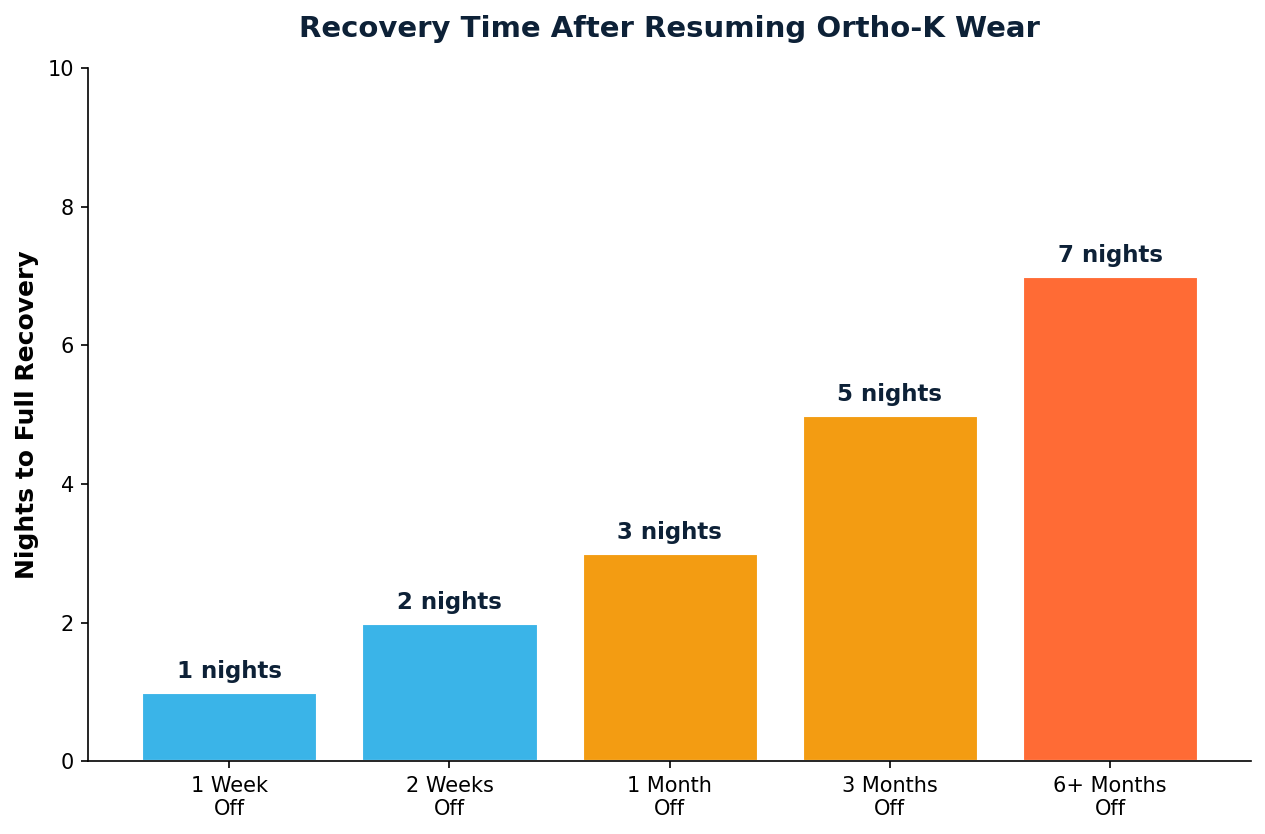
The good news is that the recovery is usually faster than the initial adaptation period. Your corneas have already been through the process, so they respond more quickly to the lenses.
- Night 1: After just one night of wear, most patients wake up with a dramatic improvement in their vision. You might be 70-80% of the way back to clear, crisp sight.
- Nights 2-4: Within a few days, you should be back to the same excellent, stable, all-day vision you had before you stopped.
This chart shows the typical vision recovery timeline when you start wearing your lenses again:
It’s that simple. No long, drawn-out process. You just pop your lenses in at night and get back to your life.
Why Flexibility is a Game-Changer
So why do I call this reversibility a feature? Because life isn’t static.
I have patients whose jobs require them to deploy for months at a time where lens care might be difficult. They can simply stop wearing their lenses, use glasses for that period, and resume when they get back home to Fayetteville. No problem.
I have young patients in Cumberland County Schools whose prescriptions are still changing. With Ortho-K, we can adjust their Myopia Control treatment as their eyes grow. With surgery, you have to wait until everything is stable, losing precious years when we could be slowing down their prescription changes.
And sometimes, people just want a break. They want to wear funky glasses for a while or just not think about lenses. Ortho-K gives you that freedom. It puts you in the driver’s seat of your own vision care.

A Note on Insurance and Payment
sleepSEE® myopia control is a specialty service not covered by insurance. This includes plans like TRICARE and Blue Cross NC. However, flexible payment options and HSA/FSA funds are accepted to make the treatment affordable for our families.
Frequently Asked Questions
1. Will stopping Ortho-K make my vision worse than it was before? No, absolutely not. Your vision will simply return to your pre-treatment prescription. It cannot make your eyes weaker or your prescription higher.
2. Can I wear soft contact lenses during my break from Ortho-K? It’s best to stick with glasses. Soft lenses can interfere with the cornea’s return to its natural shape, which can make it harder to get an accurate prescription measurement or resume Ortho-K wear.
3. How long of a break can I take? You can take a break for as long as you need—weeks, months, or even years. When you’re ready to restart, we’ll have you come in for a check-up to ensure the lenses still fit properly and your prescription hasn’t changed significantly.
4. Do I need new lenses if I restart after a long break? Not necessarily. Ortho-K lenses are durable and can last for a year or more. If your break was long and your prescription changed, we might need to design a new pair. But if your eyes are stable, you can often use your existing pair.
5. What if I only skip one night? Skipping a single night will likely have a minimal effect. You might notice your vision isn’t quite as sharp at the end of the next day, but it will be functional. It’s not ideal, but it’s not a disaster. Just get back on schedule the following night.
6. Is the regression process uncomfortable? Not at all. You won’t feel any physical sensation as your cornea changes shape. The only thing you’ll notice is the gradual, gentle return of your blurry distance vision.
References
- Bullimore, M. A., & Johnson, L. A. (2020). The Safety of Orthokeratology—A Systematic Review. Eye & Contact Lens: Science & Clinical Practice, 46(5), 277-284. https://journals.lww.com/claojournal/Abstract/2020/09000/The_Safety_of_Orthokeratology_A_Systematic.2.aspx
- Sandoval, H. P., Fernández de Castro, L. E., Vroman, D. T., & Solomon, K. D. (2005). Refractive surgery survey 2004. Journal of Cataract & Refractive Surgery, 31(1), 221-233. https://www.jcrsjournal.org/article/S0886-3350(04)00973-X/fulltext
- American Academy of Ophthalmology (AAO). What is Orthokeratology? https://www.aao.org/eye-health/treatments/what-is-orthokeratology
- Lipson, M. J., & Boland, B. (2018). The evidence for orthokeratology. Review of Myopia Management. https://reviewofmm.com/the-evidence-for-orthokeratology/
Last reviewed: February 2026
Free Download: Is Ortho-K Right for Me?
A self-assessment guide used by candidates evaluating ortho-k vs. LASIK vs. contacts.
- Candidacy criteria (prescription range, corneal shape)
- Ortho-K vs. LASIK vs. daily contacts comparison
- 5-year cost breakdown
- Questions to ask your provider
Is Ortho-K Right for Me?
For Adults — Free Self-Assessment
sleepSEE Clinical Team
The sleepSEE Clinical Team is a group of licensed eye care professionals dedicated to evidence-based education on myopia control, orthokeratology, and nonsurgical vision correction.