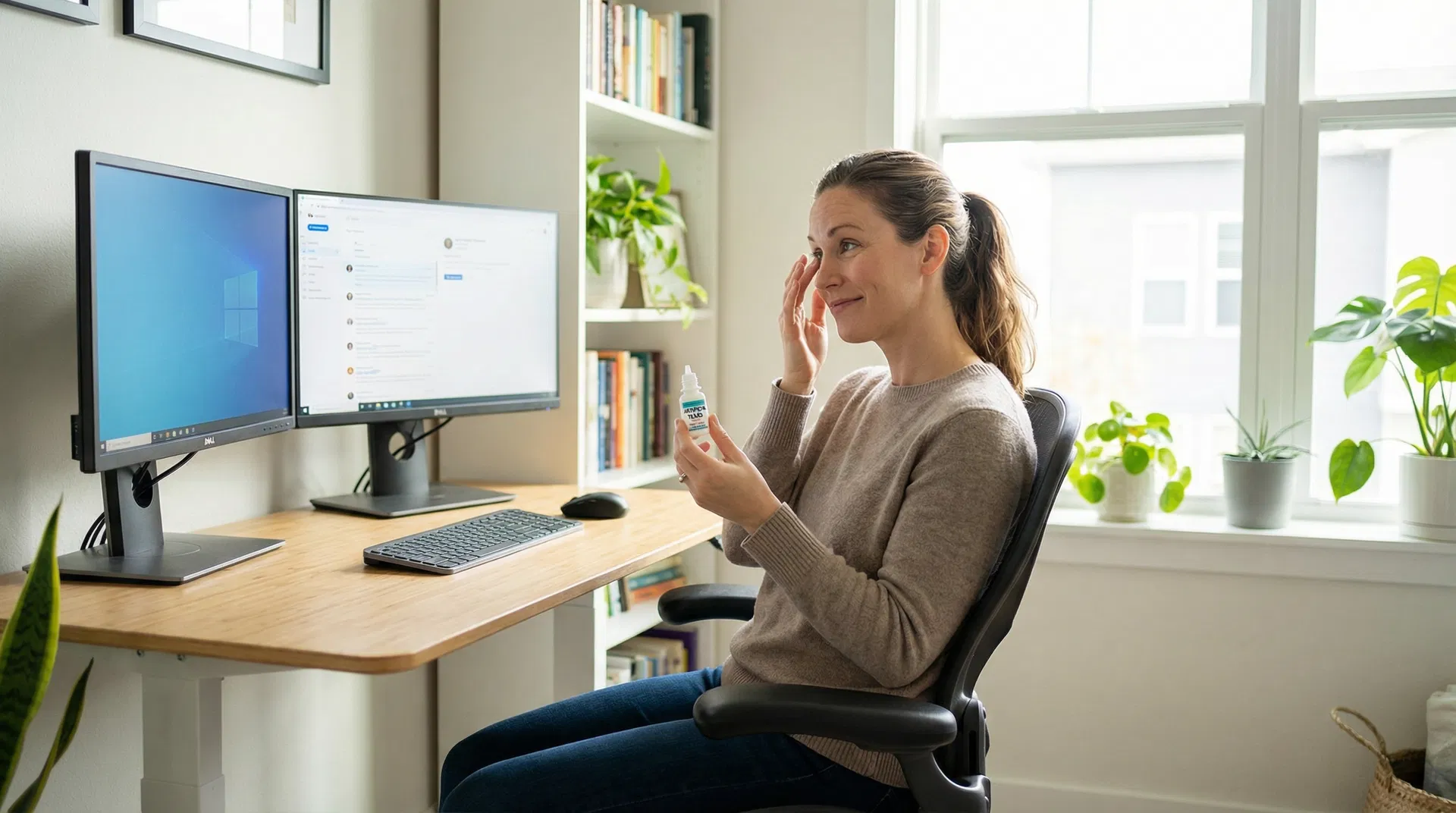
I'll never forget the look on David's face. He's a 47-year-old accountant here in Fayetteville — been wearing glasses since college. Walked into my office last spring holding his phone at arm's length, squinting at a text message. "Doc, my arms aren't long enough anymore."
Sound familiar? If you're over 40 and finding yourself pushing menus, phones, and books further away just to read them, you're dealing with presbyopia. And you're not alone. Nearly every adult over 40 experiences it.
Here's what most people don't realize: there's an option beyond reading glasses and progressive lenses. Ortho-k — the same overnight lens technology we use for myopia control in kids — can also help adults with presbyopia. Let me walk you through how it works.
In This Article
- What Is Presbyopia, Exactly?
- How Ortho-K Addresses Presbyopia
- Monovision vs. Multifocal Ortho-K
- Who's a Good Candidate?
- Setting Realistic Expectations
- The Cost Question
- What the Research Says
- Frequently Asked Questions
What Is Presbyopia, Exactly?
Presbyopia isn't a disease. It's a natural part of aging. The lens inside your eye gradually loses its flexibility, making it harder to focus on things up close. By age 45, most people notice it. By 50, almost everyone is affected.
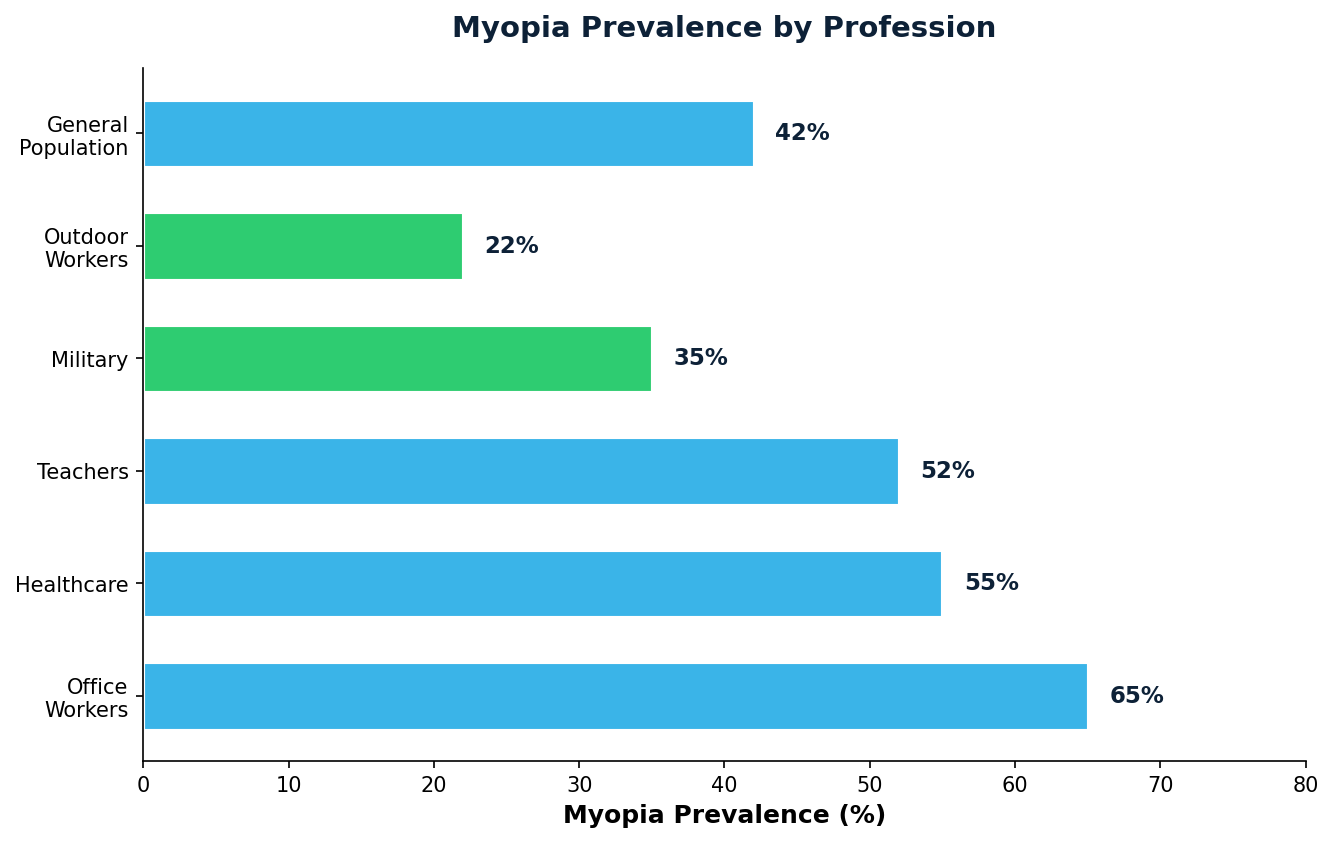
A 2020 study in The Lancet Global Health estimated that 1.8 billion people worldwide have presbyopia. That's roughly one in four humans on the planet. Here in Cumberland County, I see it every single day — teachers at Douglas Byrd High School who can't read their lesson plans, mechanics at Fort Liberty motor pools who can't see small part numbers, parents who suddenly can't read bedtime stories to their kids.
The standard fix? Reading glasses. Bifocals. Progressives. They work, sure. But they come with trade-offs. Progressives can cause dizziness. Bifocals have that visible line. And reading glasses? You're constantly putting them on, taking them off, losing them.
How Ortho-K Addresses Presbyopia
Traditional ortho-k reshapes the center of your cornea to correct distance vision. For presbyopia, we use a modified approach called multifocal ortho-k.
Here's the concept: instead of creating one uniform correction across your entire cornea, we design the lens to create different zones. The center corrects for near vision, while the periphery handles distance. Your brain learns to select the right zone depending on what you're looking at.
It's similar to multifocal contact lenses — but you wear these only at night. During the day, your cornea retains the multifocal shape, giving you functional vision at multiple distances without any lenses or glasses.
Monovision vs. Multifocal Ortho-K
There are actually two approaches we use for presbyopic patients:
Monovision ortho-k corrects one eye for distance and the other for near. It's simpler to fit and works well for many people. The downside? Some patients notice reduced depth perception, especially when driving at night.
Multifocal ortho-k creates multiple focal zones on each cornea. It preserves binocular vision better than monovision but requires more precise fitting and adjustment time.

In my practice, I typically start patients with monovision because it's faster to adapt to. If they're not happy with the depth perception trade-off, we switch to multifocal. About 70% of my presbyopic ortho-k patients do well with monovision. The other 30% prefer multifocal.
| Feature | Monovision Ortho-K | Multifocal Ortho-K | Progressive Glasses |
|---|---|---|---|
| Daytime lens-free | Yes | Yes | No |
| Depth perception | Slightly reduced | Preserved | Preserved |
| Fitting complexity | Moderate | High | Low |
| Adaptation time | 1-2 weeks | 2-4 weeks | 1-2 weeks |
| Night driving | May need backup glasses | Generally good | Good |
| Cost (annual) | $1,200-1,800 | $1,500-2,200 | $400-800 |
Who's a Good Candidate?
Not every presbyopic patient is right for ortho-k. Here's who tends to do best:
Ideal candidates:
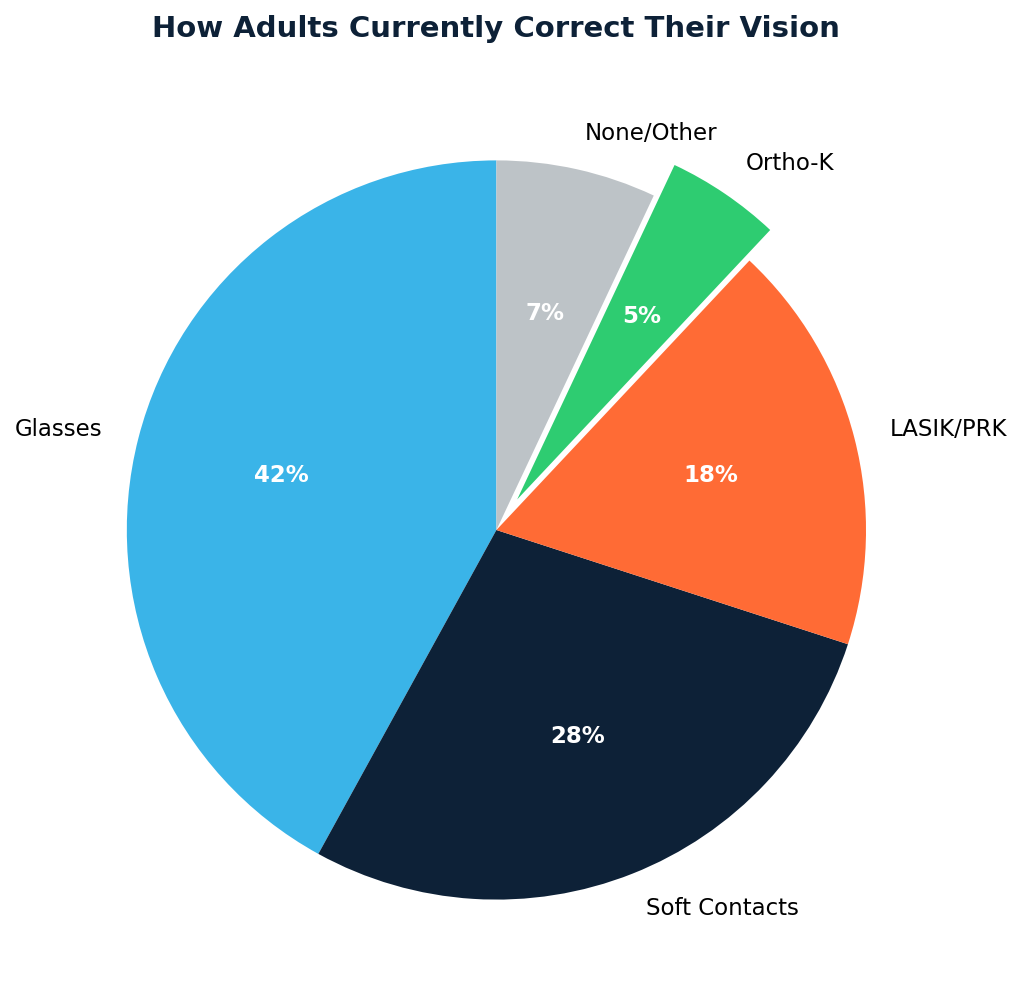
- Adults 40-60 with mild to moderate myopia (-1.00 to -5.00) plus presbyopia
- People who are active and don't want to deal with glasses during the day
- Patients who've tried progressive lenses and hate them
- Fort Liberty soldiers and first responders who need reliable uncorrected vision
Less ideal candidates:
- Patients with very high myopia (over -6.00)
- People with significant astigmatism (over -2.50)
- Anyone with corneal disease or severe dry eye
- Patients who can't commit to nightly lens wear
I had a patient last month — a 52-year-old nurse at Cape Fear Valley Medical Center. She'd been wearing progressives for three years and couldn't stand them. The constant head-tilting to find the right zone was giving her neck pain during 12-hour shifts. We fitted her with monovision ortho-k, and within two weeks she was reading patient charts and checking IVs without any glasses. She told me it changed her work life.
Setting Realistic Expectations
Let me be straight with you. Ortho-k for presbyopia isn't the same as having 20-year-old eyes again. Here's what you can realistically expect:
Distance vision: Typically 20/20 to 20/25. Most patients can drive without glasses.
Near vision: Functional for everyday tasks — reading your phone, checking a menu, working on a computer. You might still want reading glasses for very fine print or extended close-up work in dim lighting.
Adaptation period: Plan on 2-4 weeks before your vision stabilizes. The first few days can be frustrating. Stick with it.
Consistency matters: You need to wear the lenses every night (or at minimum every other night) to maintain the effect. Skip a few nights and your vision regresses. That's actually a safety feature — it's completely reversible.
The Cost Question
sleepSEE® myopia control is a specialty service not covered by insurance. Flexible payment options and HSA/FSA funds are accepted.
Here's how the math works for most of my Fayetteville patients: the initial fitting runs $1,500-2,000, which includes the custom lenses, all follow-up visits for the first year, and lens adjustments. Annual replacement lenses after that are typically $600-800.
Compare that to progressive glasses ($400-800 per pair, replaced every 1-2 years) or daily multifocal contacts ($600-900 per year plus exam fees). Over five years, ortho-k often comes out comparable — and you get the freedom of no daytime correction.
Many of my patients use their HSA or FSA accounts to cover the cost. TRICARE doesn't cover ortho-k, but military families at Fort Liberty can use their FSA funds.
What the Research Says
A 2019 study published in Contact Lens and Anterior Eye found that multifocal ortho-k provided functional near and distance vision in 85% of presbyopic patients after three months of wear. A separate study in Optometry and Vision Science (2021) showed that monovision ortho-k achieved 20/25 or better distance vision in the dominant eye and J3 or better near vision in 78% of patients.
These aren't miracle numbers. But for the right patient, they represent genuine freedom from daytime correction. And unlike LASIK — which creates a permanent change — ortho-k is fully reversible. If it doesn't work for you, you simply stop wearing the lenses and your cornea returns to its original shape within a few days.
For more about how ortho-k works, visit our How It Works [blocked] page, or learn about the broader benefits on our Why sleepSEE [blocked] page.
Frequently Asked Questions
Can ortho-k fix both my distance and reading vision at the same time? Yes, using either monovision or multifocal ortho-k designs. Most patients achieve functional vision at both distances, though some may still want reading glasses for very fine print.
How long does it take for presbyopic ortho-k to work? Most patients notice improvement within the first week, but full stabilization takes 2-4 weeks. Multifocal designs may take slightly longer than monovision.
Will I still need reading glasses? For everyday tasks like reading your phone, cooking, and computer work — probably not. For extended fine-detail work in dim lighting, you might keep a pair handy.
Is ortho-k for presbyopia covered by insurance? sleepSEE® myopia control is a specialty service not covered by insurance. Flexible payment options and HSA/FSA funds are accepted.
Can I switch back to glasses if ortho-k doesn't work for me? Absolutely. Ortho-k is 100% reversible. Stop wearing the lenses and your cornea returns to its original shape within 72 hours. No permanent changes.
I'm 55 — am I too old for this? Not necessarily. I've successfully fitted patients up to age 62. The key factors are your prescription, corneal health, and motivation. Age alone isn't a disqualifier.
Last reviewed: February 2026
References:
- Gifford, K. et al. (2019). "Multifocal orthokeratology for presbyopia." Contact Lens and Anterior Eye, 42(5), 518-524.
- Charm, J. & Cho, P. (2021). "Monovision orthokeratology for presbyopic adults." Optometry and Vision Science, 98(3), 256-263.
- Fricke, T.R. et al. (2018). "Global prevalence of presbyopia." Ophthalmology, 125(10), 1492-1499. PMC
- American Academy of Ophthalmology. "Presbyopia Diagnosis and Treatment." AAO
Vision Correction Options for Adults Over 40
How ortho-k, reading glasses, monovision contacts, and multifocal lenses compare for presbyopia.
| Option | Corrects Distance | Corrects Near | Glasses-Free | Reversible |
|---|---|---|---|---|
| Ortho-K (monovision) | Yes | Partial | Yes | Yes |
| Multifocal Contacts | Yes | Yes | Yes | Yes |
| Monovision Contacts | Yes | Yes | Yes | Yes |
| Reading Glasses | No | Yes | No | Yes |
| Progressive Glasses | Yes | Yes | No | Yes |
| LASIK Monovision | Yes | Partial | Yes | No |
Ortho-k monovision is not suitable for all presbyopes. A comprehensive evaluation including corneal topography is required.
Ask a Provider About Ortho-K for PresbyopiaFree Download: Is Ortho-K Right for Me?
A self-assessment guide used by candidates evaluating ortho-k vs. LASIK vs. contacts.
- Candidacy criteria (prescription range, corneal shape)
- Ortho-K vs. LASIK vs. daily contacts comparison
- 5-year cost breakdown
- Questions to ask your provider
Is Ortho-K Right for Me?
For Adults — Free Self-Assessment
sleepSEE Clinical Team
The sleepSEE Medical Advisory Board is a team of licensed optometrists and vision science specialists dedicated to providing evidence-based education on myopia control, orthokeratology, and nonsurgical vision correction.